Navigating Career Identity Crisis: Getting from WTF to LFG in your Career & Life
Career Identity Crisis.

It’s one of those common experiences among sensitive, multi-passionate, social impact-driven professionals. They ask themselves, “W.T.F. am I doing with my life?” They know they want to make the world a better place, but they may not feel confident knowing where their skills fit in, what industry or field is particularly right for them, or what cause will continue to motivate them when the work gets tough.
What causes Career Identity Crisis (CIC)? It might not be what you think. I argue that CIC doesn’t happen just because of a layoff, a department restructuring and your role changing, or realizing your boss is toxic and needing to leave a job.
No, the conditions for creating CIC start wayyy before that.
The villain origin story of Career Identity Crisis:
In the United States, growing up in a capitalist society, so much of our conditioning teaches us that we are what we do for work. As kids, adults ask us what we want to do when we grow up- and they always mean what job do we want to identify with. This teaches us that our adult identity is built around what we do for work. Especially in the northeast U.S. where I’m from, it’s common when people are meeting for the first time to ask “what do you do?” and they often respond with what they do for work. Common advice for college graduates is “figure out your work first, then build the rest of your life around it.” (Side note: My advice is the opposite, no matter where you are in your career: figure out what you want your life to be like first, then figure out a job to support you in that).
Consider the American values and how we’ve been taught we need to work hard for the “American Dream”. In the US and many developed countries, we have normalized spending 35 or more hours a week, all but a few weeks a year, doing the thing that earns us a paycheck so we can afford to pay bills, buy food, support our family, and “live a good life” as we were taught.
And we stigmatize not working. If you aren’t busy working hard to earn, buy/consume goods, and contribute to the capitalist system in a significant way - which you can do if you come from wealth, work to earn more and more money by climbing the career ladder, then the question we ask ourselves is “what are you even doing?” What about when we stop working like taking career breaks for our mental health or having other life priorities beyond working? The stigma makes it so that if we appear not to be working hard, not contributing to the capitalist system, we risk being judged or looked down upon.
We have been conditioned to emphasize our identity in how we earn a paycheck while perpetrating the stigma against people who are not working or have other priorities beyond paid work.
(Capitalism is the root of a lot of our social and economic injustices: patriarchy, ableism, racism, classism, and and and…but that’s for another blog post, or ten.)
So, as you can imagine, when it feels like work isn’t going well, perhaps someone gets laid off, or there is a threat of unemployment - it can feel like everything isn’t going well. Hence, the feeling of Career Identity Crisis. These experiences - changes in a job or work status - can help surface the feelings of Career Identity Crisis, but these aren’t the root causes. The root causes go deeper than work status.
The 3 Root Causes of Career Identity Crisis:

houseplants
Outgrowing - You may be someone who often outgrows the pot you’re planted in. Some plants are slow-growing cacti and don’t need to make changes that often. Some are like philodendrons; they grow quickly and need to be repotted in a bigger pot so they can keep growing and thriving. Maybe your needs are changing, no longer met by your current job situation. Perhaps you have changing interests or crave learning something new.
Questioning your Belonging - Call it “imposter syndrome” or call it “internalized supremacy culture” (more on that in a future blog), but this can be a lack of confidence in yourself, questioning whether you have what it takes to make an impact, tempted to find the easier thing you know you are qualified for rather than stretching yourself to something that challenges you or puts you out of your comfort zone. You may be surrounded by people who don’t support you in ways you need support, or make it hard for you to advocate for support, which exacerbates these feelings of not belonging.
Listening to Others More than Listening to Yourself - When I say “listening to others,” that can mean taking advice from friends or family, and can mean doing things to impress or satisfy other people’s expectations (or your perceptions of) rather than your own. When I say “listening to yourself” I mean checking in with that all important and super valuable intuition of yours. Your gut feelings.
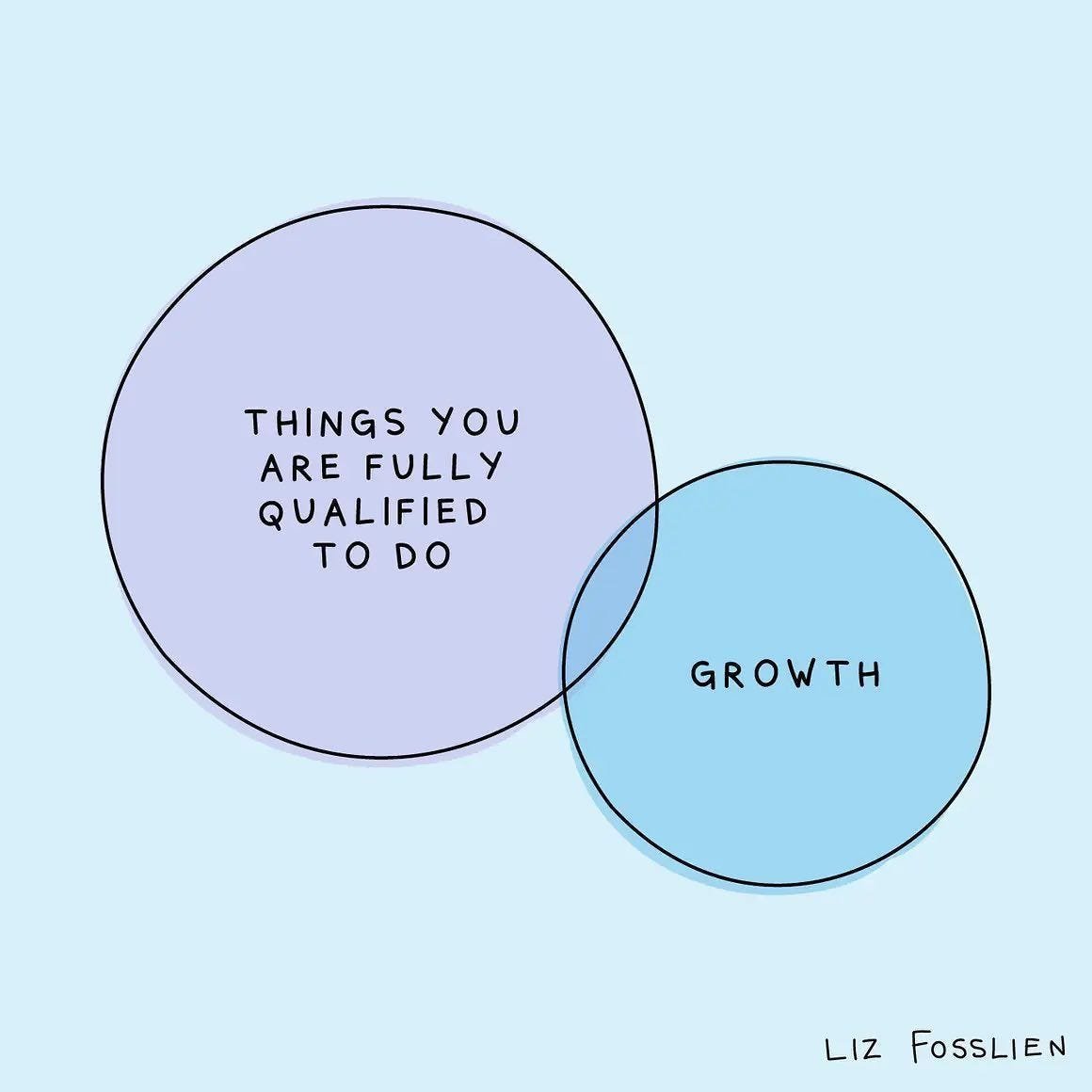
Let’s face it, life as a human is uncomfortable. In most scenarios, there is worthy discomfort (in which we experience growth, healing, or self-discovery and expansion. For example: you feel nervous to finally start a class you’ve always wanted to take, start a new hobby that energizes you, ask your long-time crush out on date) and there is unworthy discomfort (which leaves you feeling drained, unsatisfied, or -worst case- even traumatized. For example: staying too long in a friendship, relationship, or job where you’re mistreated. Not worth it.). The thing that helps us recognize which is worthy vs. unworthy discomfort is our gut.
Your gut is going to tell you what’s a “hell yes” even if it is scary, new, or tests you. Your head is going to tell you all the things that will protect you and keep you safe (“don’t do it if it’s risky”). Your gut is going to tell you what would feel like a disappointment if you were denied the chance to at least try. When we force ourselves out of our comfort zone against what our gut tells us, we may not be ready or the decision may not be right for us. Asking our gut questions and listening is a skill we can learn and practice. We can ask our gut yes-or-no questions like:
Is this a challenge I’m excited about?
Is this a worthy cause for my efforts?
Through my many experiences with career identity crises over the years, they’ve evolved with me. At one point in my career, I was in a CIC because I had outgrown the pot I was in and needing new challenges to learn from. In another job, I was too busy listening to others and pursuing things that I thought would make me look accomplished or impressive to others rather than making decisions that felt energizing to me. Now a few years deep into my own coaching business, my career identity crisis has little to do with outgrowing. The business tests me in new, interesting ways every day. It also has little to do with listening to others more than my own intuition. I often use learning what others suggest as a litmus test for my own intuition. I have learned to listen to how my gut reacts to someone else’s suggestion with an internal “that’s cool, I want to learn more” or “that’s not for me right now.”
My career identity crisis these days mostly comes from episodes of rejection sensitivity - a common experience for those with ADHD brains - and questioning my belonging. I’ll have moments of uncertainty, self-doubt, and asking “W.T.F. am I even doing right now?”. Then I remember the tools in my toolkit that best help me navigate out of it. This can look different for every person - which is why it can help to work with a coach to figure it out.
My deep personal experience with Career Identity Crisis is why I became a coach. I knew I could help others navigate out of it and build their toolkits to move more swiftly through that process than I had. I’ve tried on a few different titles over the years - Career Confidence Coach, Career Strategist, Luminous Coach, Self-Discovery Coach - but ultimately, I’ve been doing the same work since I started: helping social impact-driven professionals navigate out of Career Identity Crisis. I help people go from “W.T.F. am I doing?” to “L.F.G.” in their careers, businesses, and life.
As I worked with more and more clients and saw more and more patterns, I built my coaching framework around what I’ve seen work.
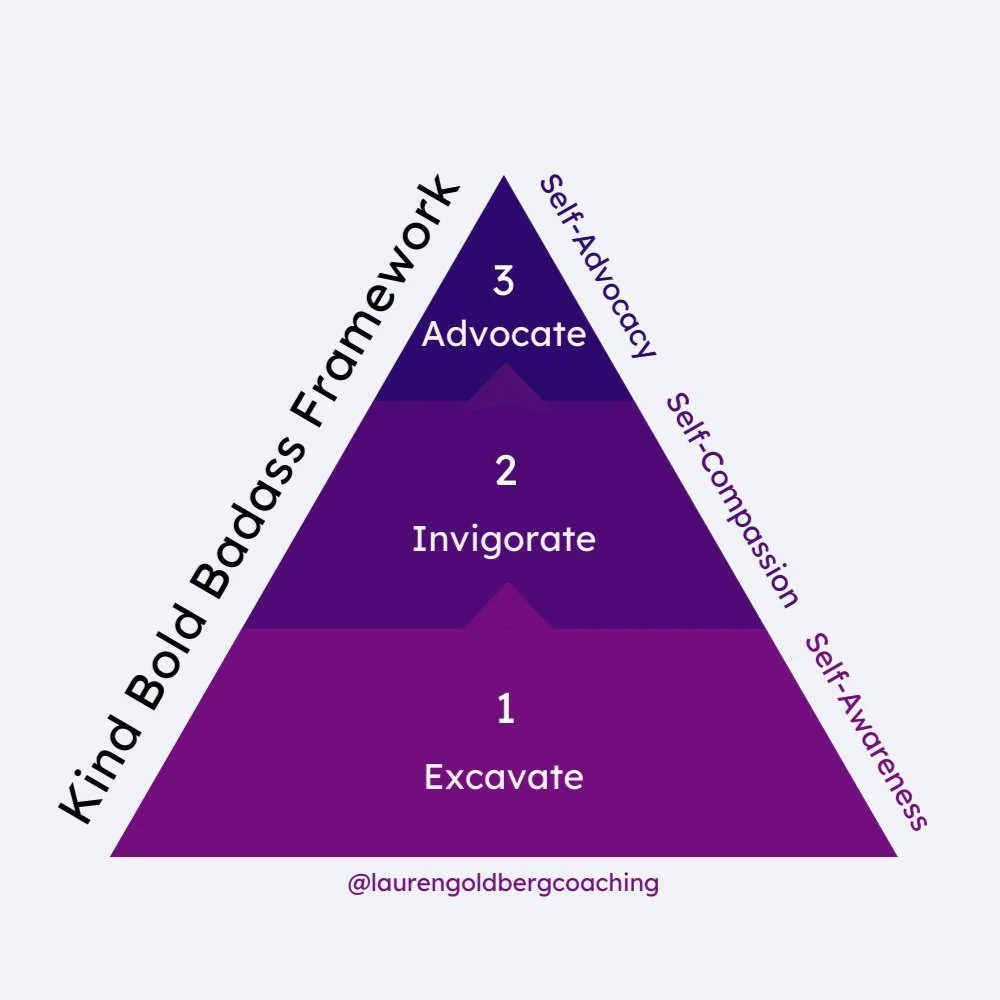
The 3 Building Blocks to Navigate out of Your Career Identity Crisis:
Excavate - Chip away and remove the weight of what everyone else is telling you to do, what other people’s expectations are of you and your career, what B.S. cultural standards we’ve been taught. Trust your gut. As one client told me, “I need to listen to my gut to build trust in my gut.” Discover separate identities that make you you, beyond what you do for work.
Invigorate - During times of self-doubt and lack of motivation, figure out what completes your body’s natural stress (fight, flight, or freeze reaction) cycle. This is where you strengthen your self-compassion muscles. Once you can quiet your inner bully and listen to your inner super fan, jump into taking intentional action. As your energy allows, the more you take action, the more you learn from it. The insights you have about what you want and don’t want, need and don’t need will inform your next move.
Advocate - Because of building block two, Invigorate, you have taken action and have more information, with which you can make plans and feel confident in your intentions. Advocating is about protecting your time and energy so you can move forward with your intentions. This includes standing up for yourself, reaching out to others for support, and enforcing boundaries when someone oversteps. When you advocate for your non-negotiable needs and energizing opportunities, you get closer to what you want with more clarity.
Not only does this process help my clients find career confidence and success, take steps towards achieving their dreams, and create a life they only imagined for themselves…something more important happens.
In this life, you are who you will spend the most time with. Learning to love that person is one of the most worthy causes (and worthy discomforts!). When you do the work coaching requires, it changes how you see yourself, and how you treat yourself. That changes the way you exist in the world. And that ripple affects the impact you have on others. That shit feels like magic.
And I wish I could shout this from all the rooftops. If more people truly love and embrace themselves as they are, not only would there be a lot fewer identity crises, but the world would be a much different place. Let’s build that world, together.

I’m in the business of changing lives. I’m a career-focused Self-Discovery coach. I help:
Those feeling like a career/life identity crisis and don’t know how to figure their way out.
Social impact professional who want to use their careers to create a better world but don’t know how yet AND not let it take over their lives.
Those who have experienced an ill-fitting or toxic work environment and want to avoid it in the future
Book an exploratory call with me and we’ll figure out a plan to work together.
