Podcast Episode: Designing with Disability in Mind with Lauren Goldberg
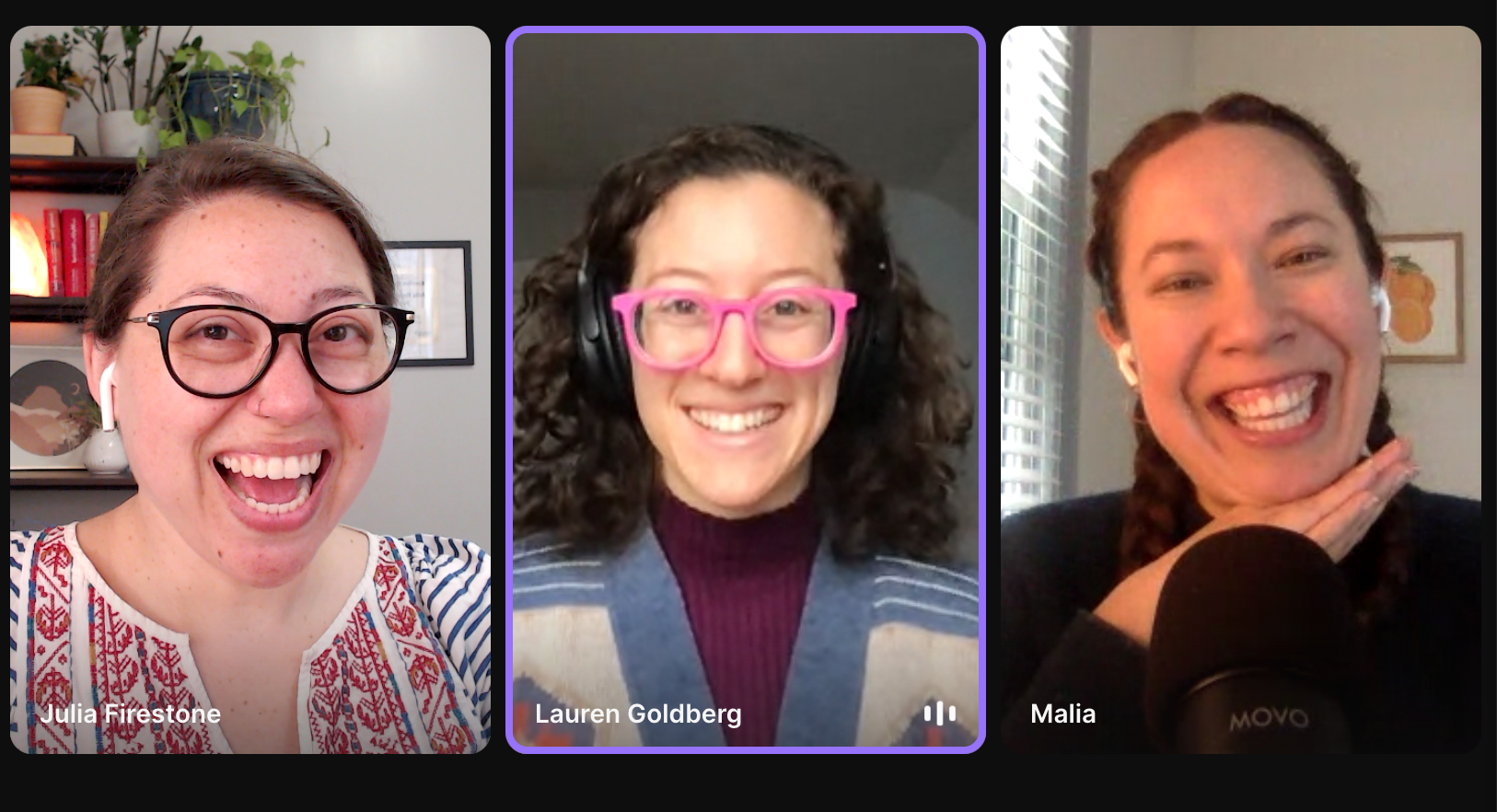
Screenshot Julia Firestone, Lauren Goldberg, and Malia Wright-Merer, each in separate video boxes and smiling as they record their podcast episode.
By the end of the podcast episode recording, the hosts and I were getting choked up 🥹
This week, I joined Malia Wright-Merer and Julia Firestone on their podcast, The Cozy Impact Pod.
I started off talking about how much I felt I needed to hide and cover up my disabilities with perfectionism, intense competitiveness, and performance all the time when I was younger.
By the end of the episode, the hosts used me as an example of what it looks like to celebrate and embrace who you are and let your unique light shine. 🥹 How could I not get choked up?
In this episode, we introduce disability justice concepts like accessibility, ableism, internalized ableism, masking, accommodation, body doubling, and the distinction between organizations providing disability accommodations or services vs. those changing the status quo.
Correction Note: In the episode, I say that “1 in 5 people in the US has a disability.” That is 1 in 4 people in the US.
The Cozy Impact Pod - Episode 9 Description
What would it look like if we all had the support we needed? What would it feel like if we were able to self-accommodate and have more space for accessibility and adaptability in our lives and work environments? We are exploring what it is actually like to be in self-accommodation, have the conversation around disability, and ask for adaptability. How to create more space for possibility and honoring where our bodies are. We have invited our FIRST guest, Lauren Goldberg, a proudly disabled and neurodivergent social impact entrepreneur, to join us in the conversation!
Listen to the episode and/or read the transcript below:
-
Malia (00:01.435)
Hello, hello.
Julia Firestone (00:03.425)
Hello?
Malia (00:05.211)
Welcome, welcome!
Julia Firestone (00:07.193)
Welcome back everyone!
Malia (00:10.683)
Welcome back. We're back and I'm so excited that we're here. We have our first guest today. Lauren Goldberg. We're so excited.
Julia Firestone (00:18.865)
Ooh, I'm so pumped. We have really like much more amazing things to say about Lauren before we get into welcoming Lauren to the stage. I just wanna set the scene here. So picture this, soft blankets, abundant plants and nature, a fire in the fireplace and dear friends.
You are in your element, feeling energized and nourished by the setting and sense of community. Welcome our friends to the Cozy Impact Pod, a virtual embodiment of this experience where we open the door to topics that impactful people and conscious leaders constantly think about, but rarely get to talk about. We're destigmatizing, playing and laughing our way to a greater sense of belonging for our friends in helping professions.
from social entrepreneurs like ourselves to activists, nonprofit and social impact folks, educators, and anyone who wants to contribute to making the world a better place, welcome home. I am as ever so delighted to be here with Malia Wright-Merer, who is such a wonderful human being. And I think by this point, you should probably know who Malia is, but just in case you don't.
Malia lives deeply for curiosity, creating open spaces for detangling and exploration. She focuses on transformation in the field of DEIA with a background as a counselor in integrative somatic healing, and some call her wise earth mama.
Malia (02:04.955)
Hi, Julia. I'm so happy you're back. Also, Julia just got refreshed in Costa Rica. I just want to name how nice that is. And Julia Firestone here is an ICF certified transformational coach who partners with social impact do -gooders and troublemakers to help find your unique spark, take up space, and thrive.
Julia Firestone (02:11.441)
Ha ha ha.
Julia Firestone (02:15.633)
Very nice.
Malia (02:32.379)
Some call her the social impact fairy godmother. And I'm always so honored to be here with you. And today is especially so special because we have our first guest on a topic that is so near and dear to my heart, integrating accessibility and accommodation. And we have our friend, Lauren Goldberg here. So I'm just gonna share your bio a little bit about yourself. And.
Lauren Goldberg is a social impact entrepreneur and disability justice advocate. Her North Star is to help people learn tools they need to be confident change makers. As a career and business focused self discovery coach, she helps social impact professionals find and pursue what lights them up. She is proudly disabled and neurodivergent. She also is known to make fire on a dance floor. Hold up.
I wanna see that.
Lauren Goldberg (03:31.29)
I'm so honored to be here with you. I'm excited for our conversation and yeah, maybe we'll have a little dance party at the end and make some fire.
Malia (03:42.299)
I really hope we do.
Julia Firestone (03:44.785)
Yes, please.
Malia (03:46.171)
Now I'm thinking about like how fast do you have to go to make the fire? I'm excited about that. But Lauren, we are so excited you were here because Julia and I have been talking about how we really want to do, and this will not be the only one, of course, an episode around disability, around accommodation, around accessibility. Of course, there's so much there. And Lauren and I were able to connect before while Julia was...
Lauren Goldberg (03:52.066)
I'm sorry.
Malia (04:15.995)
on the beach somewhere, I'm sure, on a boat. And we had such a great conversation talking about disability, talking about accommodation and self accommodation. And that's really what we want to talk about. Really, what is accommodation? How do we talk about these things? Whether you have a disability or you're non disabled right now at this moment, what does that mean for everyone involved?
Lauren Goldberg (04:18.914)
Hahaha.
Malia (04:45.819)
So we're really in this conversation of rethinking the way we think about the world and ourselves and finding adaptability. So Lauren, something that we talked about in our chat last week was how you listen to our work hard episode. And it really resonated with you as I think it does with a lot of people. And the big question of that was how did we learn that...
Lauren Goldberg (05:07.052)
Mm -hmm.
Malia (05:14.011)
things have to be so hard. So I'd love to just hear a little bit about your experience with that and anything that does come up.
Lauren Goldberg (05:15.936)
Mm.
Lauren Goldberg (05:22.242)
Yeah. So first of all, I want to congratulate you on the name change of your podcast. And I truly did feel like the coziness and the inspiration and the impact of what you were talking about last episode are really like just...
really resonated with me and I just loved the whole vibe and your voices were so soothing. It was just like the perfect Friday thing. But yeah, the question that you posed about when did we learn that things needed to be hard? And it really was such an obvious answer for me that I learned that things had to be hard when I...
when I really used perfectionism and intensity and performance to cover up what felt like things I was taught I needed to cover up, masking and not letting anyone know that there was quote unquote anything wrong with me and just feeling like I can't like...
I can't let anybody know that I don't have it together, assuming that having a disability made me broken somehow. And that's like, obviously the, you know, that's not what is wrong with me. That's not a wrong way to be. What was wrong was all of the internalized ableism and just...
Malia (07:10.179)
Mm -hmm.
Lauren Goldberg (07:18.082)
kind of learned, like learned to look down at myself because I had disabilities. And so my adulthood has been a lot of unlearning of that and embracing my identity as a disabled person. So yeah, I know we'll talk more about that, but I think that like a lot of my learning that things needed to be hard was in...
putting in all of the effort to kind of hide who I was. And yeah, and now I do everything I can to embrace that and self accommodate really.
Malia (08:04.827)
Yes, I really hear that. And for those of our listeners who are not familiar with the term ableism, I just wanted to chime in and just share that it's really the discrimination against disabilities or people with disabilities. And this could be overt as, you know, obvious as, you know, you don't belong to covert, as in having a zoom training without captions or
Julia Firestone (08:06.065)
Yeah.
Malia (08:33.511)
having an event where there isn't any availability for someone to access the event and kind of that neglect in some ways. And so really there are so many ways that ableism shows up in our world and how we start to view ourselves from that lens. And I love that you shared that and yeah, thank you for being here and sharing that. And I know we're going to dive even more about this.
And something that we were really curious about in this conversation was what does accessibility look like to you, whether to yourself or to our communities or our environments? And I want to hear from everyone.
Lauren Goldberg (09:17.824)
Yeah.
Well, accessibility to me is designing an experience with everybody's unique needs in mind. Right? I think that we can recognize all of the ways that the world has been designed for able -bodied people. And if you need, if your needs are...
Julia Firestone (09:21.297)
Hahaha.
Lauren Goldberg (09:50.222)
kind of outside of the like what's average it it it
Lauren Goldberg (09:59.052)
It is something that it takes more effort, right? It takes more effort. It takes more advocacy. Um, and yeah, so the accessibility is really the design of systems and experiences with unique needs in mind.
Julia Firestone (10:17.361)
That's great. And I wanted to talk also a little bit. You mentioned this term masking, Lauren, which is familiar to me as well. You and I have talked about ADHD and I've mentioned it every episode of our podcast too. And for those who might not be familiar, I'm curious from your experience, what does masking feel like?
Malia (10:17.819)
really.
Julia Firestone (10:44.913)
and how would you describe masking?
Lauren Goldberg (10:50.85)
Yeah, so for me, masking was...
just trying to be perfect all the time was very intense and competitive in sports as a kid, was like assuming that everybody is judging me and having to appear that I have all my stuff together, you know, getting good grades, like performing rather like.
Really, just not like.
It's almost as if any type of slip up or any type of like proof that I wasn't good enough was gonna be, you know, was gonna be the...
Yeah, it was gonna be.
Lauren Goldberg (11:51.81)
it was gonna validate all of my biggest fears, which is that I wasn't good enough, that I couldn't keep up, that I couldn't like, that I wasn't, that my body wasn't like everybody else's, my brain wasn't like everybody else's. And so really hiding my learning disabilities, hiding my hearing aids and not.
not talking openly about what it is that would make things easier for me. There was some level of accommodation through school and like my teachers because I had an IEP and because I had a 504 plan, but with everybody else, it was just like, I wasn't.
I didn't feel comfortable doing that in social situations, so I would really become a shell of myself.
Malia (12:55.067)
Hmm. And how did that, how did that change the way that you, I hear that there's a lot of that protective part. And that, well, let me just fight harder, right? Let me just try so hard. And you know, I'm, yeah, go ahead.
Lauren Goldberg (13:10.964)
Mm -hmm. Mm -hmm. Yep.
Yes, exactly, exactly.
Malia (13:22.427)
Oh, and something that as you were sharing that I was just hearing something I love so much about the conversation around disability and also kind of alternative ways of viewing how the way how the world works is as you were sharing that I was thinking, wow, there are so many moments that I felt that way.
Lauren Goldberg (13:42.69)
Yes.
Malia (13:50.843)
And in different ways, of course. And I think when we start to mirror what shows up in adaptability, in accommodating for ourselves, then that starts to create even more space for other people to not need to hide who they are in all ways. And actually on that topic kind of...
Lauren Goldberg (14:11.33)
Hmm.
Malia (14:18.459)
I'm curious to find out from both of you, what does it feel like trying to find accommodations for yourself? Or when have you felt like, this thing isn't working and I'm not, I'm really struggling, like doing it the way other people have done it. And now I need to figure out another way.
Lauren Goldberg (14:48.13)
I'm happy to jump in, but I also started last time, so I'll see if Julia wants to start first.
Julia Firestone (14:55.921)
Yeah, I mean, I think it's a grander experience from my part of, like you said, Lauren, effort and realizing that what felt like the baseline in terms of like everything being kind of overwhelming or intense or exhausting, that actually like that doesn't have to be the norm.
And we get used to that. It's sort of like, I feel like everyone uses this metaphor of like the how you cook a frog in boiling water, which is gross and apparently inaccurate. But it's like you get yeah, Malia is making an amazing face right now. But it's like you get used to the the norm of like.
Lauren Goldberg (15:27.586)
Mm.
Julia Firestone (15:50.961)
things feeling challenging all the time. And when you start to realize, it's like that unmasking process, I've started to realize, actually it doesn't have to be this hard. And finding ways, like I like to ask myself, what is the easiest way for my brain to do this task? Or even just like, what do I actually need right now?
you know, and realizing that I've been going against my own needs and like going way beyond what feels comfortable or feasible. And so I think it's, it's, it's more than like one -off experiences, but it's sort of a whole, it's like, yeah, taking that mask off and realizing that so many things could feel differently.
and could feel easier. And as Malia said at the top of this conversation, I think I got in at two in the morning last night. So also if I'm all over the place, there you go. But I'll pass it to you to learn because I'm curious. We're adapting. I'm curious about your experience with, I guess starting to, yeah, how you started to realize that maybe.
Malia (17:02.363)
We are adapting.
Julia Firestone (17:17.585)
the built environment wasn't meeting your needs and like what needed to change about that.
Lauren Goldberg (17:32.002)
So I think the, my relationship with my disabilities has evolved a lot over the years. And it really wasn't until I started learning sign language, like even just a few years ago and learning about deaf culture and embracing my own identity as somebody with, with deafness, I as like, as a deaf person, um, like that.
I learned the incredible ways in which an entire population has learned, like not learned, but has.
has just has other ways to thrive in the world. Right. And I think when you when you grow up in mainstream culture, it's like there's there's a right way to do things. You know, we learn that in our families, we learn that in school, like there's a right way to do school. There's a right way to like do adulting. There's just like and it's really like actually there are so many.
so many ways to thrive in this world that just need the space, the awareness, the visibility, so that other people can really see like, oh, I don't need to fit myself into a box. I can adapt and I can find other ways that work for me. So...
Yeah, that's, I feel like I could really like break into a tangent and talk in more detail about that. But I just, you know, yeah, I wanna hear more about what your thoughts are.
Malia (19:22.445)
Yeah.
Malia (19:26.331)
Well, I love that you talked about school. I think there is a lot of school conversation that comes up, especially here. And, um, you know, an exploration of unschooling things that we've learned. And I, you know, you were saying that right there and I was like, Oh my gosh, I resonate with this so much in different ways. And, um, something that I, I can't remember if we brought this up in, in this podcast yet, but.
Lauren Goldberg (19:37.386)
Mmm.
Malia (19:55.971)
So I have dealt with dyslexia and reading was really hard for me. Reading was really hard, yeah. And so, and I do have tools now that help me. I sometimes, this is so funny, but when we were reading the bios in the beginning, I was like having this proud moment because I was like, look at me read a bio.
Lauren Goldberg (20:06.466)
Same, same.
Lauren Goldberg (20:25.126)
You did great! It sounded great!
Malia (20:25.527)
out loud. There's this internal, internal, but there's an internal pride and, and I think a lot of that actually came from acting school. I really had to trick my brain into finding ways to read, especially read out loud. But when I, especially when I was growing up, I really struggled to reading. I really struggled with reading comprehension. My brain would not,
Lauren Goldberg (20:28.866)
You made me sound so good.
Malia (20:55.011)
retain information and I think we talked, Julia and I talked about this on a previous episode around school and you know you were saying, Julia said, I'm I wasn't really good at math or science and I was like I actually did okay in those like reading like I felt like I tried so hard and I still like I would get like a C or something on the reading comprehension test or whatever.
Lauren Goldberg (21:12.482)
Mm.
Malia (21:24.187)
And I just remember thinking at that age, this is so hard and why, like, why is my ability to not understand or no one's really teaching me techniques or teaching me ways to look at words differently or how to look at a sentence structure in a different way. No one's asking you to do that. People are just saying, read it. You know, we'll teach you how to read letters, but not how to read.
Lauren Goldberg (21:36.706)
Hmm.
Malia (21:52.987)
in a different way and my brain needed something. And I actually, I was, I don't know if anyone uses Libby, the library audio or they have virtual books and audio books, but they have a dyslexia print font. And the first time I read it, I was like, what? This is so easy. This is so much easier. And...
Lauren Goldberg (22:04.994)
Yes.
Lauren Goldberg (22:08.898)
Yes. Yep.
Malia (22:19.579)
I felt so validated in that way that there was something there. And I do still read, you know, print books, but I just noticed that no one was really teaching me. I don't know if I had the words to vocalize. I think I just wasn't doing well in that subject matter. I think even to the ACT and the SATs, that was always the subject matter that I struggled with the most. And I remember always just feeling confused.
Lauren Goldberg (22:43.53)
Mm.
Malia (22:46.715)
and why can't I just get it? Why can't I just understand it? Why can't I just read the material and then get it? And I feel really grateful because I studied acting and as you know with acting, there's a lot of scripts involved. But a huge part about that was script breakdowns and sentence structures and how you.
look at a thought or a phrase or you know you would take your pencil and write all over a script and write slashes like circling words and so through that you know decade that I was in that that exploration of constantly going through words and finding the way that words go together and and you know I can read I now can look at the beginning of a word and an end of a word and not jumble up the word and so um
Lauren Goldberg (23:35.616)
Mm -hmm.
Malia (23:37.755)
But it feels really good, but I didn't have anyone who really knew how to teach that to me. And this kind of off of this topic, it makes me think about what are the things that you wish you knew how to talk about when you were younger? If you could kind of go back and tell yourself, or if you could think of either a parent or an authority figure, a teacher.
What kind of things would you have wished somebody would sit you down and say, hey, let's look at this a different way? And Julia or Lauren, I'd love to hear you come up because now my brain's going on that.
Lauren Goldberg (24:23.734)
I mean, I, okay, so so much of what you said resonates with me. I feel like so much of my like, like, um,
triggers, if you will, like whatever triggers my anxiety, like kind of brings me back to experiences in school where you have like timed math tests and timed, you know, like reading out loud and doing all of the things that were just really hard for me. And yeah, I mean, I know I got extended time on tests once I did get kind of diagnosed and.
like put on plans, I did get extended time, but it's like when you ask that question, there isn't something that I, well, okay, I'm gonna come back to what I would say to like authority figures, but I wish that there had been less shame in me around being slow and doing things slowly and doing things like thoroughly. Like I have said this in a,
Malia (25:23.803)
Hmm.
Lauren Goldberg (25:30.21)
some of my coaching webinars that I just don't do anything quickly except run. I ran track. So I was, right? Like I was an athlete, but like anything other than running as fast as I could, like I do really slowly. And that's not a wrong way to be. That's not a bad, like that's not a bad thing. I'm not a bad person because I take a long time to do things. So there was a little bit of like, I wish I could go back and like,
Malia (25:37.243)
I'm sorry.
Lauren Goldberg (25:59.81)
tell myself and.
and be able to confidently communicate to other kids who are like, why does it take you so long on tests? Why are you so slow? I wish that I was able to just be like.
you know, that's not a wrong way to be. There's nothing like, there isn't anything wrong with me, you know? And then for authority figures, I don't have anything like super specific other than the way that we educate in mainstream schools are just, they're not, it's not meant for everybody. And...
Julia Firestone (26:23.055)
Yeah.
Lauren Goldberg (26:46.498)
There are special schools for people with dyslexia or deaf schools, and there are other schools that can accommodate for disabilities. But if you are sort of where I fall, like in the in -betweener, right? I was hard of hearing, but I wasn't like full, I didn't grow up in the deaf community. I'm deaf with a lowercase D, not an uppercase D.
Um, you know, I have ADHD and dyslexia, but I like being in the special ed classes, like wouldn't have fit me either. I was kind of like in this in between place. And so I don't have an answer to, you know, I don't have solutions, but I just know that the way I was taught you had to do school. Um, yeah, that's just, it's, it's not.
But I will say as an adult and as somebody who's like working, who
doesn't have the, you know, you don't have like a 504 plan, you don't have an IEP plan, you like are advocating for yourself, you're, now I'm working for myself, so I am my boss and I'm accommodating myself, like it's a whole new world and kind of level of like learning self -compassion and learning what works for me and my brain and my energy and yeah, so it's a whole new world.
Julia Firestone (28:25.169)
I feel like that's a, yeah, I feel like that's a perfect segue, Lauren. And I think Malia, you and I also probably had answers to that question, but it feels like such a perfect moment to talk more about self -accommodation, which is this concept that you've been talking about a lot, Lauren, and you're now offering these self -accommodation coaching sessions. And I'd love to hear like,
What is your hope for that experience, for the experience your clients would have from that session or what they might take away from it? But even before that, how did you land on that idea?
Lauren Goldberg (29:03.52)
Mm -hmm.
Malia (29:05.197)
Thank you.
Lauren Goldberg (29:06.25)
Mm.
Lauren Goldberg (29:10.626)
Yeah, yeah, so I am going to be completely honest, the self accommodation work that I do is I do that with every client, regardless of what kind of like whatever the goal is, self accommodation is like one of the ways that we're going to get there. So what I really wanted for people was to see that, you know, the way that we were talking before about like,
we have learned that there is a right way to be and there is shame around not being able to fit into that box or feeling like it's so exhausting to force myself into that box, right? Working, for example, like not all of us are working at an optimal level from nine o 'clock in the morning to 5 p .m. Right. It just that's like not how it works for us and our energy. And so that's just one example. And two.
show people that there are no rules and we can make up our own rules as long as we are accomplishing the ultimate goal. Like that is really like the how is.
Lauren Goldberg (30:24.45)
is something that we can set for ourselves based on our non -negotiable needs, like our energy, our, like, you know, setting up an environment for ourselves where we thrive. So like a really small example of that is like, I cannot just like decide to do laundry and complete the task of doing laundry, like all the way through to folding it. Like it takes me just, I forget about it. It's like.
I can set timers and I'll be like, oh, it's fine. I'll, you know, I'll snooze the timer and then, and then I have a pile to fold and I won't want to fold it. And like, there are shame around me being like, why can't I just do laundry? Like I'm supposed to do laundry. Like that I've been taught, like adults do laundry this way. Right. And for me, my brain, my energy just doesn't, just doesn't work like that. So for me, I need to do laundry parties.
Right, either my husband and I do laundry together and we fold together and we talk and like, that's how we kind of like get through it and hold each other accountable to finishing it. Or I'll actually call a friend or call my mom and like catch up while I'm folding laundry. Right, so this is like maybe like another way that I accommodate myself and not just like kind of stay in this like...
this place of internalized ableism and shame. Like, why can't I just do it? Why can't my brain just like finish it? Another thing you were talking about reading before, right? So I also use Libby. I also use the dyslexic friendly font. And if it is a book that I'm really having a hard time with, I'll also get the audio book for it. I'll also rent, you know, through the library, the audio book.
So I'll listen and read and I'll sort of alternate and that will help me like get through it. So, you know, they're just like, there might be shame around somebody being like, that seems so like, that seems so, what's the word? Like over, like that just seems so extra, right?
Julia Firestone (32:44.079)
Hmm
Lauren Goldberg (32:44.418)
But those things to me are not extra. Those are necessities. Those are necessary for me to accomplish the goals, accomplish the things that I want to accomplish. And it feels good in the end, but it's like I also want to feel good about the how, the how I'm going about doing it, how I'm accomplishing the task, and not forcing myself into a box and feeling like, you know, like,
feeling like I need to do everything the one way that I've been taught.
Julia Firestone (33:18.417)
Um, yeah, I mean, that brings me back to our, that podcast episode we did on why things have to be hard and why is there shame about making an experience feel joyful or pleasurable? Um, so I, I love that example you gave about, uh, what I would, I would describe as body doubling for getting the laundry done. You're sharing.
Lauren Goldberg (33:42.026)
Mm. Yes.
Julia Firestone (33:44.881)
the experience with another person or even having that phone call with someone else, you know, gives you a container of time and space to be, you know, getting through it. But I love that. And so it sounds like, Lauren, you've been really learning for yourself and building these practices that do integrate self accommodation that make it
easier and more pleasurable, more joyful to approach, you know, adulting and life's daily tasks and work.
Lauren Goldberg (34:25.282)
Yeah, and work too.
Julia Firestone (34:30.211)
Yeah. And so I'm curious coming back to that. Oh, sorry. Go ahead, Malia.
Malia (34:34.395)
guys.
Malia (34:38.875)
you go.
Julia Firestone (34:40.689)
Okay, I was just gonna say coming back to that question of like, what is your hope for how your self accommodation sessions or coaching in general serves your clients, you know, because you're bringing self accommodation frameworks into every coaching session, it sounds like. What is your hope for how that shifts things for your clients?
Lauren Goldberg (35:01.152)
Mm -hmm.
Lauren Goldberg (35:08.13)
So my hope is that I can help shift my client's self -perception of themselves. I just think there are so many ways in which we are taught that we are wrong, that we are bad, that we are doing things the way we're not supposed to be doing them, that there's a right way to be, and that there are so many reasons for us to believe that we're not good enough.
And so if I can show people that there are creative ways for us to accomplish goals, it's like you, I talk, you know, like I was an athlete, so I often use sports analogy. So like the...
Malia (35:36.537)
Mm -hmm.
Lauren Goldberg (35:56.098)
The game, like we can still play the game, but we may just need to, we don't necessarily need to move the goalposts, we just have to change the rules, like how we play the game, right? Change the equipment, right? Just like making it so that.
Malia (36:10.233)
Hmm.
Lauren Goldberg (36:19.358)
V.
We don't need to be so strict about the rules, right? Like I said before, like in so many instances, rules, there are no rules. We make up the rules, right? Like, right? So just, so being able to just...
Malia (36:27.323)
Next minute.
Malia (36:33.915)
I'm sorry.
Lauren Goldberg (36:42.05)
convince or show people that level of self -compassion and change their self -perception that they're doing things wrong or they're doing, like, they're, you know, for whatever reason, not good enough. I just feel so strongly that...
There are so many other ways to thrive in this world and ableism really keeps us trying to fit ourselves into a box that we, you know, when we are a completely Koosh ball, starburst, unique, ever -changing shape. And so, yeah, I just feel super strongly about that.
Malia (37:13.049)
Hmm.
Malia (37:34.075)
It's so interesting, right? That just thinking about all of the ways that that societal will tell us, stay in this box, stay in this method, stay in this rhythm so that it keeps going, that it keeps feeding, you know, that can also feed into capitalism, that can feed into other, you know, the intersectionality of all of these things, these things linked together. And what starts to happen when we do think outside of the box is that,
Lauren Goldberg (37:52.45)
Yes.
Malia (38:03.323)
it doesn't funnel down to benefiting one person, it funnels down to benefiting all of us. And that is the collective care, that's the community care. I loved what you said about breaking the rules or rewriting the rules and this is just kind of a funny little anecdote, but my husband and I, we view rules very differently.
Lauren Goldberg (38:08.586)
Mm -hmm. Yes.
Malia (38:26.455)
So I'm, I love to just, you know, I'm like, okay, it's a rule. So like someone made that up and we could break it. And then if someone really doesn't want us doing that thing, then I guess we won't. But how important is this rule? And so he feels like, well, it's a rule. It should be there. There's a reason why somebody placed it there. But when it comes to laws, he's like, laws should be broken.
Not all laws, of course, but he's like, somebody just created a law to benefit someone else. And I'm like, no, you can't break a law. But it's interesting how we respond to order and how we see what feels comfortable for us to change and what we feel bound to.
Lauren Goldberg (38:55.042)
There you go.
Mm -hmm.
Malia (39:21.659)
And I love having that conversation with him because we view it differently. I'm the kind of person that's like, okay, they say don't go past this, you know, fence because, you know, they probably, well, hopefully it's not private property or it's like a safety thing. And I'm like, you know, I agree, safety. And also I'm a smart person. So if I go over here.
I think I am aware of my surroundings. I can't guarantee that everyone's gonna be aware of their surroundings. But I'm not saying people should go past safety lines. Don't do that. Unless it's really safe. And he's like, no, no, no, we shouldn't, we shouldn't, don't go there. But I think that is interesting. What rules we place on ourself? What ideals we place on ourself? What feels...
comfortable and also when it doesn't feel comfortable, how did we learn that and who told us that and what did we see in society and kind of what you're saying. It's like I love what you said about the goalpost. It's like the goalpost is not changing. You can still get your ball in the goal. But how are we playing the game? And I really resonate that with that in so many ways.
Lauren Goldberg (40:37.474)
Mm -hmm.
Malia (40:42.299)
I know Julia and I have talked about this a lot. I love that Julia, you brought up body doubling as an accommodation tool because both of us have talked about when we're on our own, it's sometimes really hard to have energy to do things. Sometimes we have spurts of energy, sometimes we don't. Something I've loved over the last few weeks is I was with my family in Hawaii and Julia while I was there.
did all this podcast stuff, like creating a new write -up and website and all these things while I was on vacation. And then while Julia was gone, I edited all of our episodes and you don't know this, but I were connecting it to go on Spotify too. So.
Julia Firestone (41:30.577)
I do know it, I got an alert, which is so exciting. You did, yes, your podcast is now on Spotify. Thanks Malia.
Malia (41:34.427)
You got an alert! So exciting. So you can listen to it. This is exciting! So you can listen now on Spotify, and we'll have other platforms too. But something we check in with each other a lot is what do we have energy for? What can we pick up? How can we be of support to one another? Because we both know that we don't have that same consistent energy all the time.
Lauren Goldberg (41:55.2)
Mm.
Lauren Goldberg (42:03.306)
Hmm.
Malia (42:03.867)
And that is one of our accommodation tools and how we work together, which has been so supportive. Or, you know, we'll say, let's both get on a call and do the thing together. So we don't feel like we're doing it alone or, or build up that feeling of, oh, why can't I do this? Why don't I have the energy? Why don't I, why can't I do this as quickly as somebody else could? I should be better.
And I also wanted to mention the feelings of the shoulds. My husband is ADHD, you mentioned this before. Josh, if you're gonna listen to this later, I really hope you do, this is great. But hey, I love you. But he definitely goes through those periods of, I loved your laundry party idea. It's that same feeling of.
well, why can't I just do the laundry? Why can't I act like an adult and do the laundry? And just hearing you say that and your experience, and I know Julia's experience and a lot of other people with ADHD or neurodivergence have this experience and by hearing it out loud, it just creates this as a norm, a new norm or dismantling normalcy in general.
Lauren Goldberg (43:22.786)
Hmm.
Mm -hmm. Yep. Yeah. And that's actually like, I mean, that's how I, that's how I differentiate between organizations that care about...
Julia Firestone (43:26.961)
Yes.
Lauren Goldberg (43:43.456)
DEI and disability justice, right? Like there are organizations out there who say like, we care about disabilities and they offer disability services. But then there are the organizations that are like, we care about disability justice and we care about doing things in a way that...
like takes all of our employees' needs into concern. Like we are not just trying to squeeze the most out of people, but we are like trying to.
Lauren Goldberg (44:21.766)
not like, like the way that they work is also dismantling normalcy. And unfortunately, what's normalized is like squeezing the most out of people like trying to, you know, wellness in the name of like productivity as opposed to just humans thriving, right? It's just like, it's a different, it's a different...
Julia Firestone (44:41.839)
Hmm.
Malia (44:45.851)
Oh.
Lauren Goldberg (44:50.562)
It's a different tune, right? It's just a different way of looking at disability and like how you work is one way that you disrupt the system.
Malia (45:05.499)
It's so true what you said about wellness as a tool to maintain that. Because, you know, how many times have you seen, we offer a meditation class. So now that we offer a meditation class, you better work hard.
Lauren Goldberg (45:19.778)
Yeah, like the work hard, work hard, play hard. Like it's, you know, it's not...
Malia (45:20.411)
You better get to work!
Julia Firestone (45:24.975)
Yeah.
Lauren Goldberg (45:30.434)
There's just, there's so much language out there.
especially in the corporate world where companies are saying like, we provide all of these benefits too because we care about our employees' mental health. And a lot of the benefits don't actually lead to better mental health.
Lauren Goldberg (45:59.49)
what does provide a good environment for mental health is like having a supportive environment, having compassion, like being flexible, being, you know, they're like, just, I just believe so strongly in like setting a culture around that. It's just, yeah, you know, before I was a coach, I was working in people and culture initiatives and it just like something that,
I was tasked with was program design for employee motivation. And so this was, you know, I just look at everything with a disability justice lens. So that's, that's where I'm coming from.
Julia Firestone (46:46.537)
Lauren, I didn't actually know that about your background. Can you, what are some of the things that you did in that role? I'm really curious.
Lauren Goldberg (47:00.194)
So what I was doing when I was working in employee experience was making sure that people felt a sense of belonging within the organization. And that is a really hard thing to do as an individual contributor, just working as a project manager on an HR team.
Because what I learned through that is that so much of people's sense of belonging and psychological safety and mental health when it comes to like, as it relates to work, comes from their leadership and their management and how supportive those, like how supportive the culture is.
So that was like some of the stuff that I was paying attention to when I was working in that.
Julia Firestone (48:04.369)
Yeah. And I guess like building on that, this idea of bringing a disability justice lens to whatever you do, whether it's in that corporate setting or in your own business, I think, yeah, for all of us, I'd love from you, Malia, too.
I'd love to talk about how a disability justice lens and framework benefits everyone and what is possible in this world if we bring that to kind of everything we do.
Lauren Goldberg (48:39.554)
Hmm.
Lauren Goldberg (48:55.106)
Yeah, I'm happy to give a great example of that. So one, you know, it's not even a metaphor. It's like a literal, like just perfect display of how designing for disability benefits everybody is the ramps in sidewalks. So sidewalks that have ramps.
at intersections.
But in addition, like the ramps that have the bumps on them, like the bumpy surfaces, it doesn't just benefit people who are using wheelchairs, it benefits people who are blind and walking and crossing the street. It benefits people with walkers. It benefits people with strollers. It benefits...
just people who are walking and not paying attention and then they get to a, you know, get to a point where they feel the bumps underneath their feet and they're like, Oh, this is an intersection. I should probably take my eyes off my cell phone. Yeah, exactly. So it really is like, if we designed so many other things like that, it would just, the benefits go beyond, you know, people with mobility disabilities.
So I just love that example to illustrate that point.
Malia (50:32.251)
I love what you're sharing too and little funny story about this. I know how fantastic it is that those bumps are there. I broke my ankle in August and I was using a scooter and I remember how hard those bumps were to go over every time. And I was like, I know these are beneficial. Oh.
Lauren Goldberg (50:43.33)
Oh no!
Lauren Goldberg (50:54.058)
Oh no, yeah.
Lauren Goldberg (50:59.65)
Oh yikes.
Malia (51:00.219)
but I had an internal grudge to them because I think everything was kind of hard to get around and roll over, but especially with smaller wheels, it was really difficult. And I was like, but also it's good because I'm not gonna run into the intersection on my own in case something happens. But I just thought it was really, really funny, but also amazing that there are ramps. And...
Lauren Goldberg (51:19.648)
Ugh.
Malia (51:27.003)
And something that I was thinking about as you were sharing that was the innovation that happens from adaptability. And there are so many daily used things that were created by the disabled community because they were adapting, texting, right, cruise control, a lot of these things, the automatic doors and...
things that we use all the time, like every single person uses all the time that were created and adapted because someone needed to think about things a different way. And this also applies to how we approach our worthiness and how we approach how we show up in the world and self -advocacy too is, you know, the three of us here are having this conversation of,
Lauren Goldberg (52:09.728)
Right, right.
Malia (52:26.235)
oh, the way that we were told that we were supposed to be doing things wasn't working. And we really struggled with that, which was whatever way that was. And it made me feel like I wasn't enough. And I got to a point where I said, no, I don't want to wait around to be enough in the eyes of this ideal. And how amazing is it where at that point,
things start to happen that you didn't think were possible. And opportunities start to happen that you didn't think were possible. And people start thinking in different ways that you didn't think were possible. And it is always, this is what I love about this exploration of adaptability and the ways that we move forward is what starts to happen if we were always thinking in this way, what is possible then?
Lauren Goldberg (53:04.)
Mm -hmm.
Lauren Goldberg (53:19.84)
Right. Yes.
Malia (53:22.935)
Lauren, I'd love for you to share what one of the people you were studying with talked about. There are disabled people and.
Lauren Goldberg (53:30.946)
Yes, yes. So this actually like I thought of that exact quote when you were saying how you broke your ankle and you know, you, you had mobility equipment to help you. And I know you tell that story makes me think that maybe you need like shock absorbers on on those things, right? But but that's a perfect. That's a perfect example of this quote, which comes from Julie Harris.
Malia (53:44.249)
Mm -hmm.
Malia (53:50.619)
Oh my gosh, yes!
Lauren Goldberg (54:00.8)
who's also a disability advocate, and she says there are disabled people and there are not yet disabled people. So at some point in your life, you will experience a disability, whether it's temporary or whether it's permanent, whether you are sick or pregnant or just your body ages and your needs change. So that's something that...
Like you said, if we thought more about that, and especially with such an aging population, the disability minority is the largest in the entire world. I think in the US alone, there's one in every five people has a disability. And that may even be under -reported, actually. So that's a lot of people.
Yeah, and you were talking about other things that we probably don't even realize were designed because there were people with disabilities that, but there's a better way to do this. Bringing it back to sports again, the two examples I think of are signs in baseball and huddles in football. Those things you would not have even necessarily thought about, but there were deaf athletes that were like, I need to do this a different way.
Julia Firestone (55:26.063)
What?
Lauren Goldberg (55:30.018)
And so, yeah, so that's like, there's just so, so many opportunities where we can create an environment where more people can thrive and they don't need to ask. They don't need to be requesting accommodations. It's just like understood that like, yes, we want to meet your needs. We want to design.
systems and environments in which people don't need to like overcome their, overcome their environment. Like we're not trying to overcome our disabilities. That's not how it works. We're trying to overcome ableism and ableist design.
Julia Firestone (56:12.975)
Yes.
Yes.
Malia (56:16.173)
Yes! Um, Julia, any thoughts there?
Julia Firestone (56:18.449)
And you, Lauren.
Yeah, you Lauren are someone who is putting so much good into the world with supporting clients and showing up as your full amazing self in this world and online to expand those possibilities and shift how we think.
about the built environment, how we innovate to make this a world that is more accessible, a world where we can recognize the rules that were not built for all of us that need to be broken and reshaped and rethought. And I know we are, Malia and I are so grateful that you're out here doing this work and that you are being your full self.
If folks are not already following you on LinkedIn, strongest of recommendations to do so. And you'll also see Lauren's beautiful headshots regularly that include like your vibrant hearing aids and your beautiful, we can see right now your beautiful pink glasses and just the brilliance and
Lauren Goldberg (57:45.116)
I'm
Julia Firestone (57:51.053)
vibrancy of who you are in, you know, full view, which I so love and admire. And so Lauren, Malia, you may have other closing questions, but I did want to make sure that we ask if people want to work with you, if people want to find you, where can they go? How can they connect with you?
Lauren Goldberg (58:15.97)
Um, so yeah, if you want to connect with me, um, you can check out my website at Lauren Goldberg coaching .com. Um, you can send me a DM on LinkedIn. I love that. Um, I do exploratory sessions. If you're trying to figure out if coaching is right for you and if we're a good match. Um, and yeah, I, I typically work with career changers, with business owners, um, and.
folks that are just looking to.
create self accommodations to boost their confidence, to change their self perception and.
you know, find what lights them up in a way that they know is also gonna change the world. I have to say, like, just hearing you say those really wonderful things, those really kind things, like, actually gets me choked up because, like, I talked about at the beginning of our chat, like, for so long, I was, like, hiding those things. I was hiding my hearing aids. I didn't show up as my full self. And now, like, it...
Bye.
Lauren Goldberg (59:33.978)
for me to proudly show up with those headshots of my hearing aids decorated in bright colors and to post on LinkedIn, you know, post on social media about like how, you know, how my brain works differently and like just to recognize that progress for how far I've come and to have somebody else recognize it, like say it back to you is really like, it's...
It's really amazing. So before I start crying, I just like, like, I just, I'm really grateful for this, for this opportunity and chatting with you and connecting with, with your audience.
Malia (01:00:17.147)
Oh my gosh, I want to cry. I just feel so grateful. I just thank you for being you. Thank you for showing up and all of you for whoever is listening. Hopefully this is an inspiration or just a permission that you don't need to continue to show up in the ways that are you in the best way.
Julia Firestone (01:00:20.209)
I am crying a little.
Malia (01:00:45.851)
And we're just so excited you're here and thank you so much for being here. I just, as we close, I wanted to also share, you can learn more about Julia and myself, I'm sure in the show notes, we'll put that there, LinkedIn, connect with us, email us, any topics that excite you or interest you, we'd love to explore them. Also, I'm facilitating part of a disability inclusion training that's mostly in relationship to hiring or
the working environment, changing perceptions of ability in that way. So if you are curious about that coming up in April, definitely reach out and I will share the information with you. It's called windmills. And my heart is just so full and excited and I feel that like anything is possible, tingling right now. So thank you, thank you for being here.
Julia Firestone (01:01:37.649)
mm
Malia (01:01:44.109)
Follow Lauren, follow her, read what her emails, get on her email list. Listen to what she has to say. You have such a beautiful voice and such a gift to the world. So thank you all for being here. Thank you for listening and we will see you soon.
Julia Firestone (01:02:01.425)
Thank you.
Lauren Goldberg (01:02:04.064)
Thank you. Happy Friday.
Julia Firestone (01:02:07.633)
Happy Friday! Thanks, Lauren!
I’m in the coaching business to change your life. I’m your career-focused Self-Discovery coach. Working together you will
overcome feelings of career/life identity crisis.
use your career to create a better world even when you don’t know how yet, without letting it take over your life.
find work environments that fit you and your non-negotiable needs
Book an exploratory call with me and we’ll figure out a plan to work together.
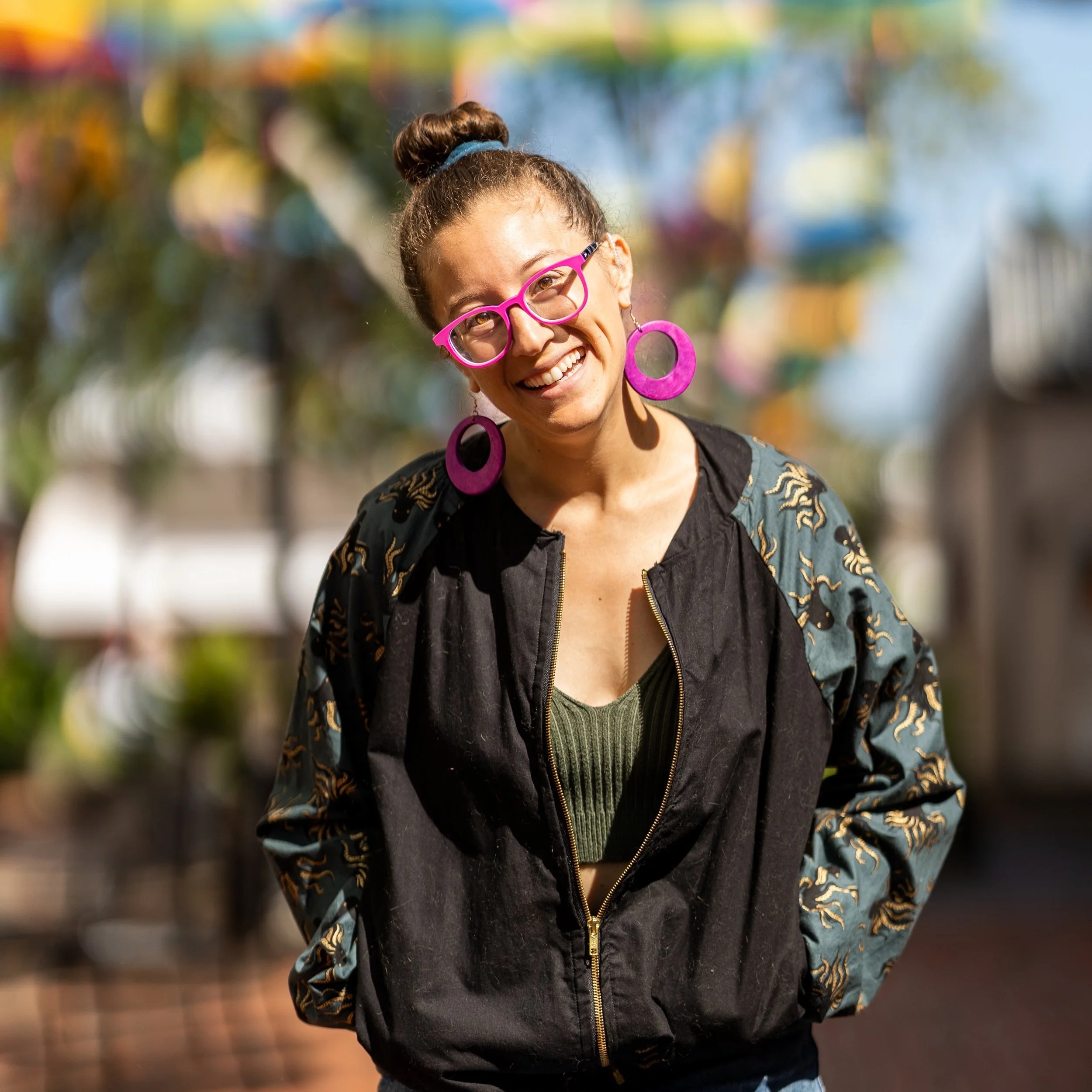
Lauren standing on a blurred brick walkway with colorful umbrellas above. She is looking at the camera with her hands in her jacket pockets, her head tiltled slightly with a wide smile. She is wearing pink glasses, blue jeans, a black and gray bomber jacket.
