Podcast Episode - From Misunderstanding to Pride: One ADHD Coach's Career and Identity Journey
Original Content from organizinganadhdbrain.com/podcast/episode/80e7d614/from-misunderstanding-to-pride-one-adhd-coachs-career-and-identity-journey:
On this episode of Organizing an ADHD Brain, ADHD coach Megs [Crawford] reconnects with Lauren Goldberg to talk about internalized ableism, disability pride, career transitions, and what it really means to work with your ADHD brain instead of against it. Whether you're looking for ADHD coaching, a supportive ADHD community, or practical ways to get organized, this episode meets you where you are.
By the end, you'll have a new lens for understanding the shame many of us carry around disability and neurodivergence, and what it looks like to slowly, imperfectly trade that shame in for pride.
Lauren was diagnosed with ADHD at age eight, but it wasn't until an ADHD reassessment for college that she learned she also had hearing loss. She shares what it felt like to hide her hearing aids, why she initially resisted identifying as disabled, and the milestones that shifted things, ASL classes, learning about Deaf culture, and eventually decorating her hearing aids as a public act of pride. She also opens up about navigating the space between hearing and Deaf communities, and the ongoing messy middle of considering cochlear implants as her hearing continues to change.
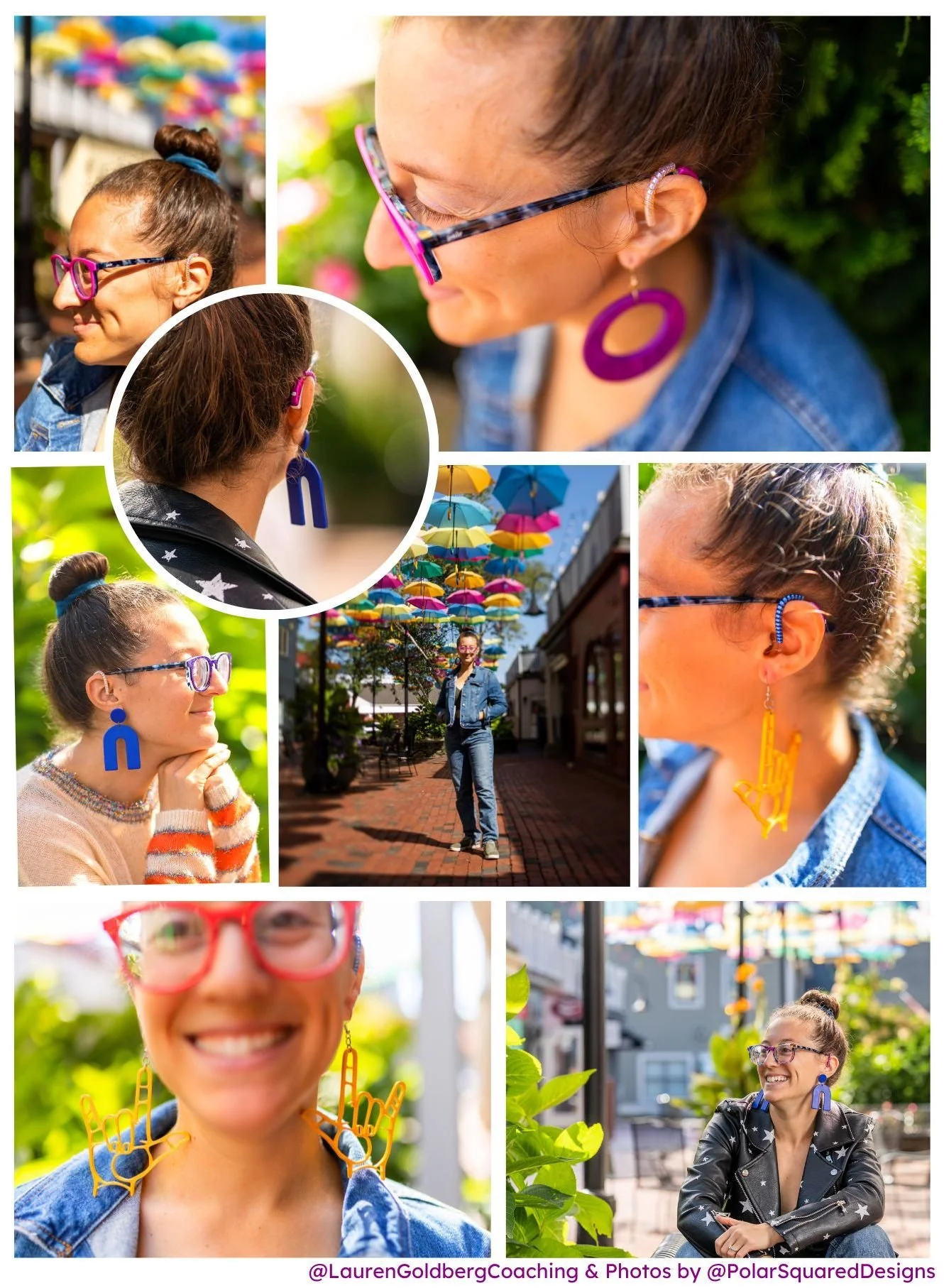
A collage of photos of Lauren Goldberg wearing different-colored hearing aid decorations, bright colored glasses, and earrings. Photos by Polar Squared Designs.
On the career side, Lauren talks about how repeated industry shifts and COVID-era unemployment pushed her toward entrepreneurship and why she moved away from digital products to focus on deep one-on-one coaching for neurodivergent clients. She and Megs dig into internalized ableism, toxic professionalism, and what self-advocacy actually looks like in practice when you've spent years masking and shrinking yourself to fit in.
The good news? The messy middle of identity isn't a problem to solve. It's where the real work and the real growth actually happen.
This episode is for anyone with ADHD who has ever felt shame around who they are and is ready to start seeing themselves differently.
Lauren Goldberg is a Career Self-Discovery and Leadership Coach who specializes in helping neurodivergent changemakers move from self-doubt to self-trust, in their careers and beyond. Diagnosed with ADHD, dyslexia, and hearing loss (AKA “deaf gain”), Lauren brings lived experience and deep compassion to her coaching, helping clients unlearn toxic professionalism, advocate for their needs, and build careers that actually fit them. She describes herself as a disco ball, reflecting your light back at you so you can enjoy it and shine it on the world.
Listen on Spotify or Apple Playlists below and view transcript below:
-
M: Welcome back to Organizing an ADHD Brain. I am so excited to introduce you to my next guest.
Last year, I have a friend who holds monthly networking events, and I met a woman through that event who held a different event where I met Lauren. And we got together because I was moving to Massachusetts, she lives in Rhode Island, and it was so cool. And then one of my other friends, Megan, who's been on the podcast before, ADHD at Work, she needed a connection in Providence, and so I connected the two of you, which was so fun. She put together a group of ADHD coaches, and you happened to reach out to see if anyone wanted to meet and chat about ADHD coaching. And it was just so funny, 'cause I was like, "Yeah, me. Let's do this." And then It was like, "Wait, I know you. We just haven't connected in a really long time." And so full circle, we are here to chat Lauren Goldberg. She's an ADHD coach, and she's gonna talk to us today about the messy middle. Welcome to the show, Lauren.
L: I'm excited that we're gonna have this conversation, and it is funny to hear you reflect back on like how we reconnected and everything. It's funny. I have changed industries multiple times, and what I have found is once you start running into the same people over and over again at various events in various spaces, you're like, you know you're in the right place. You know what I mean? so I'm excited to be chatting on your podcast.
M: Yeah. Me too. So tell us a little bit about your own ADHD diagnosis and how you got into the, world of ADHD coaching.
From ADHD Diagnosis to Coaching, Lauren's Origin Story
L: So, I feel like I'm one of the outliers. I was diagnosed when I was eight years old, and a lot of young girls don't get a diagnosis when they're younger. But my mom at the time was a disability advocate and so she kind of knew the signs to look for, and she had had, like, a previous life in like, special education. And so she, knew the signs and saw how much I was struggling in school. Like, I was a good student, but everything just felt so hard. And so I got a diagnosis at eight years old. And what's interesting about getting a diagnosis it's validating in a way, but it's also like, "Oh, yeah, okay, this proves that I'm different," you know? So I think that really, like, sat with me for a really long time.
And it wasn't until I was older that I was able to, like, explore that internalized ableism that I was experiencing. And now, in my 30s, feel a sense of pride about who I am and my uniqueness, my, how my brain operates and, I'm just, delighted by my own brain.
I feel like oftentimes with folks with ADHD, you are multi-passionate, and you very quickly outgrow the pot that you're planted in. So that kept happening to me in my career. Like, every time I changed industries, changed careers I was fascinated about the next new cool thing in front of me, and I very quickly learned what I needed to learn from that, those experiences, and then for whatever reason felt the need to move on or was forced to move on through layoff or company reorg or what have you.
Every time that career change happened, it felt like an identity crisis. And I think that's especially true for the folks who are working in the social impact, environmental impact space, where there is a cause that you sort of latch onto, and you care so deeply about it, you like, you almost take it on as part of your identity that you care about this cause, and you're like working for the betterment of like this making change.
And living in a capitalist culture where everybody asks children, like, "What do you wanna be when you grow up?" You learn to internalize, like, my job equals my identity. So each time I changed careers, it felt like an identity crisis. And it was during COVID actually that I was unemployed and had navigated once again through this identity crisis, this career identity crisis, from feeling like, "WTF am I doing with my life, my career?" And from that feeling like really strongly about what I was doing next, like with conviction, I was going into entrepreneurship. I didn't have much of a choice either because during COVID nobody was hiring right? Like the early days of COVID.
But to feel that sense of conviction and confidence, I was like, I feel like I've navigated this situation enough times now, and I've curated enough tools that I think I can help other people navigate that. And so I tried that out for a few months, and it turns out that I could. It was really transformative for the pilot clients that I worked with. And yeah, and then I turned that into a business. So what I call myself is a career self-discovery and leadership coach, and the folks that I'm typically working with are neurodivergent, have ADHD, have chronic conditions, and are facing some sort of career transition and are just looking to build their confidence and yeah, feel a sense of clarity and conviction about what they're doing next.
From Digital Care Packages to the Disco Ball Coaching Approach
M: That's incredible. One of the first things I remember about meeting you but before we actually met was going to your website and seeing that you sent out these little care packages to people going through transitions. Do you still do that?
L: I'm doing it differently. So those were career support care packages, and the way that I imagined them was they were going to be a digital product that people could either gift to themselves or gift to others. And I had never heard of something like this before other than maybe like the gift card model. I wanted to create these packages including all of these tools that I use in my coaching with clients and making them accessible to people who are going through transitions, and I curated these different care packages for different situations.
I started to sell these as digital products, and what I realized through experimenting with that is that I actually don't want in my business to be selling digital products. What I really, really enjoy is working one-on-one with people and going really deep and, like, seeing their transformation. And the impact of, a worksheet is not gonna be the same as having a deep conversation with somebody who's been there before.
I actually say on my website like, “I'm the coach for folks who can't get their answers from AI”, because it's such a different experience to be deeply seen and understood by somebody who has been in a similar boat, and just wants to focus on reflecting your light back at you so you can see it and enjoy it and let it guide you. I call myself a disco ball. I'm a disco ball coach because I'm reflecting your light back at you so you can see it and enjoy it and and, gain insight from it.
So that's, that's where I am now. I am still sending care packages for like, various marketing things, but I'm not focusing on that as a business model anymore. So that was, like, a really good learning experience.
And I actually feel that way about public speaking too. I've done various public speaking events and workshops and I still like doing those. However, it's not nearly as gratifying as, going really deep with one person and seeing them transform from the beginning of the call to the end of the call, that never gets old. I feel like that is my, if there's such thing as a calling, that's what my calling is.
And selfishly, feels good to help people. In that life-transforming way.
Defining Internalized Ableism and Why It Matters
M: I love to hear where you're at now and to see you shine as a coach. One thing that you said about getting diagnosed as a child, and I do think it's definitely rare as females getting diagnosed that early, but also not really learning about yourself until adulthood. You used the term internalized ableism. But can you define that- for the people listening? What does that really mean?
L: Yeah. So ableism is a belief that being non-disabled is superior, and the way that this shows up is in so much of our culture. It's like in our language, in the way that we design spaces and buildings, in, the way that we think of work and professionalism. It's a way of prioritizing non-disabled people over disabled people who are already at a disadvantage because of the world not being designed for their needs.
So internalized ableism, that is, like, part of your own belief system about yourself, your perspective. And so for me when it came to ADHD and feeling like school was just so hard. I did well in school but only because I tried so hard and I stayed up so late doing all my homework and I studied so hard for tests and quizzes. It was so effortful to get through grade school.
And what I kept telling myself and asking myself was like, "Why?" Why am I so different?" Like, "Why does it feel like my brain is broken?"
And then similarly, when I was actually preparing to go to college, and in order to get accommodations... So I had gotten accommodations throughout grade school, and then in order to get accommodations in college, I had to get retested, reassessed for ADHD. And as part of that assessment, they do a hearing test, and I actually failed the hearing test. And the audiologist was like, You might consider getting hearing aids because "You didn't pass this test,"
And I mean, I knew that my hearing wasn't great, but I was like just surprised to hear, to get it assessed that way. You know, in school when they, like, measure, they do hearing tests and like, "Raise your hand when you hear the beep." Well, it turns out that's, like, not a super accurate test, and you can kind of guess, like, when the beep's coming. When I found out that I had hearing loss, then similarly, the internalized ableism that came up for me was like, "My ears are broken. They don't work the way they're supposed to," and feeling a lot of shame about that.
And that really impacted how I advocated, or lack of advocacy, self-advocacy for a while, and wanting to hide my hearing aids. Like, even the way hearing aids are designed... if you have the privilege to get hearing aids, not everybody does have the privilege to get assistive technology, but at the time, I was hiding my hearing aids, and they're designed to be discreet and, like, just skin color so that people don't notice them, and it's just like the way that they're marketed is ableist.
Having just internalized so much of that, it's been a journey to try to excavate that and feel like my disabilities are a part of who I am, a part of what makes me a cool human, and gives me such a powerful perspective on the world. And I'm finding now through having my own business that a lot of the folks that are coming into my world, into my circles, are like- “the way that you talk about your disabilities is what, like, drew me in.” And so, yeah, it's been a journey.
M: I think your journey is fantastic. To be able to describe yourself as a disco ball that reflects your light back onto someone else, that's so beautiful, and it doesn't happen overnight. You know, you got reassessed for ADHD, which is hard enough on its own- you find out that you have a hearing loss, and now you're wearing hearing aids for the first time.
L: Mm-hmm.
M: First, what was it like to wear hearing aids, to be able to hear in a way that you didn't have that previously?
L: Yeah, I remember you know, the TV sounded different, the radio sounded different. I had been able to get by for so much of my life without hearing aids, but my hearing loss happens to be the middle decibel range, which is where human voices fall. So when I was hearing music, I was like, “wow, this singer's voice sounds so different.” So that's one thing I remember when I first got hearing aids at 17.
ASL Classes, Deaf Culture, and the Road to Disability Pride
M: Wow. So how does one go from getting this diagnosis or re-diagnosing and then, of course, now understanding that you have a hearing loss, into a disco ball? How do we get to disco ball level?
L: There have been various milestones that have helped me navigate that and excavating that internalized ableism.
One of those was in 2020, I started taking American Sign Language classes. And when you take an American Sign Language class, oftentimes they talk about Deaf culture and the way that Deaf people see their community, see like, how they navigate the world, how what deaf pride looks like. And that was the first time that that had ever been exposed to me before.
So not only was I learning the language, I was also learning about the culture, and it just totally blew my mind and broke the glass for me in a way that, like, you can't unsee. There are so many deaf people who love being part of the deaf community because that's, where they feel comfort. It's where they feel accepted. Sign language is its own language and the deaf community could be considered its own ethnic group because of all the ways that it's so different from other communities and, it just has that rich history and the language and everything. So it just has been really inspiring and I've continued to learn sign language.
And after I started that, I started decorating my hearing aids. So I went from hiding my hearing aids and wearing my hair down and feeling shame about them to decorating them and posting about decorating them on my social media.
And I remember the first time I did that, I was literally shaking. My nervous system was just going haywire 'cause I was like, "I can't believe that I'm, like, posting about this online." And now I th- and now I look back, I'm like, not a big deal, but at the time it was such a big deal. It was like I was exposing myself as a person with a disability. For so many years- of hiding that and, like, feeling shame about it.
And so just really, again, that's, like, kind of the bigger milestones, like chipping away at yeah, my own internalized ableism and coming to a place where I'm like, “Actually, I can be proud of who I am," and recognize that my unique experience of the world is part of what makes me proud, and I wanna embrace that .
Meg’s Experience Growing Up with a Hard of Hearing Mom
M: That's really beautiful. I'm so excited to ask you more questions about it because my mom was born hard of hearing, and she grew up with hearing aids. And my grandfather didn't want her to be a part of the deaf community, so he- had her wearing hearing aids.
But back then, there was no such thing as disability advocacy in schools, so she was- made fun of. She was chased. It was awful, the stories that I've heard. And the hearing aids back then also weren't discreet. You couldn't hide them. You had to wear them around your neck, this big thing, and then they attached to your ears. And so she would hide it under her desk, and she would just pretend. She learned so much of her life just pretending and nodding along and laughing when she saw other people laughing and reading lips like crazy.
What was interesting to me was I always assumed, definitely ableism, now that I'm knowing the term, I assumed that she always just wanted to hear. And of course, that was a thing that she vocalized, but when it came time for her to get a cochlear implant, I thought that it was gonna be this amazing experience where she was just so excited on the other end. I couldn't imagine it being anything else.
And yet she described it as it was this loss for her 'cause when they install the cochlear device, they have to take out the remaining hearing. And it was just such an interesting thing to see her go through. But it helped me start to understand the deaf community from that perspective too, is that they're not necessarily looking to hear. They're happy the way they are because- that is what they know.
And, I just loved your description of it too, you're not necessarily a part of the deaf community, but you're not a part of the hearing community either. So it's about navigating this in between of discovering who you are in this- middle of the whole thing.
The Middle between the Hearing World, Deaf Community, and Cochlear Implant Decisions
L: I know the theme this season for your podcast is Messy Middle, and that's like how I have felt and definitely still feel a bit of. Even though I grew up in the hearing world and as my hearing deteriorates, it gets harder and more challenging and more tiring to operate within the hearing world.
And then on the flip side, I'm still learning sign language, but I'm not fluent yet. I'm conversational, but I'm not that confident in it yet. And it makes Deaf spaces very intimidating. So I have to really, like, psych myself up to be like, "I'm going into a Deaf space. I'm only gonna use sign language." And really respecting their culture and their space. But I know I need to do that in order to, like, feel a part of that community and make friends and, like, really just break out of my shell. So, so there's that piece.
And then you also talk about your mom's experience with cochlear. And I'm at the point now where I've worn hearing aids for- I'm trying to do math. How old am I now? Yeah, so like almost 20 years. And my hearing has slowly deteriorated. And like the reality is that hearing aids can only help you hear so much, right? They're not like glasses where they, like, correct your sight.
M: Sure.
L: The hearing aids are assistive, but there's only so much amplification that can happen through the hearing aids. And even if I get the top-of-the-line absolute best hearing aids that are out there, there's gonna be a point where I'm not going to gain all that much in terms of like recognition, like verbal recognition, and clarity.
So now my audiologist is suggesting that I consider cochlear, and I just feel so conflicted about that because that question of like how much do I put my body through to try to exist in the hearing world versus just embracing myself as a deaf person and, like, trying to be more ingrained in the Deaf community? And I know there are so many perspectives on cochlear in the Deaf community. Like you said, like, there are a lot of folks who are like, "Don't try to fix me with your technology. I don't need that. I got my language, I got my people. I'm good," and so there is kind of this messy middle that I'm existing in where I'm like, I'm not quite sure what my next move is.
But the thing that does feel good to me is continue to learn sign language and continue to push myself to be in deaf spaces and build a community there, be part of that community.
So next week I'm actually gonna be in DC for a week-long ASL immersion, and that's, like, the most intensive thing that I've signed up for. So I'm I know it's gonna be so challenging, but I also am really, really excited to, like, to challenge myself in that way, right? To just be there, be in it, and experience the deaf community in a way that I haven't before.
M: That's so impressive that you signed up for that. I'm so excited for you. The way that you speak about putting yourself in dis- like, uncomfortable positions so that you can get comfortable with it is really powerful. And I just wanna highlight that and celebrate you for it, because that's so much of what I've noticed my own clients going through and my own self going through, is sometimes we get into this comfortable space, and it's not necessarily comfortable, so to speak, but- it feels real. It feels certain. We know what's going to happen next, and when we get uncomfortable, we don't know what's gonna happen next. But- it helps us grow. And so thank you for sharing those spaces, because, there are so many unknowns, and each person's experience is so different. And then navigating ADHD at the same time, that's a whole other thing.
I talked to this guy once who was talking to me about how to, I don't know, he said this service that he was offering that would make ADHD symptoms go away completely. It was so interesting because after the conversation, I was like, this was in the very beginning of me starting the podcast. I was like, "I don't even know enough questions to ask questions right now," because it sounded so strange. But I started to think, if someone told me that I could let go of all of my ADHD whatever that means and be someone different on the other side, would I?
I was almost a resounding no, and still thinking about it today, I'm like, I don't even know where that would put me. I'd have to relearn being this whole new person, and- what would that really mean? Obviously, that's not as realistic as what you're going through right now, a lot of us are in our own messy middle right now.
ADHD Strengths, Entrepreneurship, and Working With Your Brain
L: I appreciate that and it just makes me think of all the, like, things that I'm really grateful for because I have disabilities. Like I said, it's not always super easy because I'm existing in a world that is ableist and very much not designed with my needs in mind all the time. But what I'm able to recognize and be delighted by is how, you know, on the ADHD side, I have incredible pattern recognition. I am very creative, and
I'm able to be innovative because I can connect the dots really quickly across multiple categories of things. And I know ADHDers are not a monolith, so, everybody's got different strengths and things. But I have incredible leadership skills and perspective because of my ADHD. And I think it's also what makes me a great entrepreneur.
And I'll also say for, you know, on the note of, like, courage and being courageous, like, I feel like being an entrepreneur has continued to push me and test myself and my comfort level, like putting myself out there for the world to to see and to, like, hear my words and my voice, my perspective, and see my face and market myself and price my services. Like, all those things are like a journey in self-development that you don't expect to go on, which I'm quoting Kelly Deils on that, but it's so true. And so that kind of continues to, like, push me.
And then just going back to what I was saying before about, like, strengths. I attribute my being partially deaf- I attribute my incredible visual perspective, like being able to pick up on things visually and, my body and my brain has had to adapt to that because sound was not being processed the same way. So like, yeah, I'm also absorbing information differently because of that.
And then on top of that, I have dyslexia, so like some superpowers probably come from that too.
And it makes it a challenge for finger spelling. When you're using sign language and you use finger spelling, you're spelling out a word with letters. I still have a hard time, like, keeping the letters straight in my mind because of the dyslexia, so I have to laugh at that. But, but it hasn't stopped me.
Again, it's just, like, continued to be a challenge, a worthy challenge, a challenge that I wanna take on.
M: When I was younger, I think I had this perspective that everybody had to be this well-rounded individual that was good at a lot of different things, right? A jack of all trades, but a master of none. And yet when I find I meet individuals, everybody's good at these one or two incredible things. A- and not, not because they're trying really hard at it, it's just something that they're passionate about and they have been for a really long time, and then there's these other things that they're just falling short.
It just reminded me of the deaf community and you were talking about spelling and I'm like, "They must be such good spellers," and I have never put a lot of effort into spelling at all. There's so many things that you don't even give a thought to.
Advocacy, Owning Disability, and Shifting the Culture
It's interesting to show up and say that you're hard of hearing, because I used to introduce my mom as hard of hearing and people just wouldn't get it. And so then I would introduce her as deaf, but they wouldn't understand that either. And then now that she's older, you know, most older people wear hearing aids, and so they're like "Well, yeah, so does everyone else." Also still not getting it, and it's it's so hard to describe my mom and then to also help people understand what her lived experience. As if I need- everybody to understand when I meet them, right? That's another thing I need to work on. Like, it's okay that not everybody knows my lived experience in this space, but- it's such a messy middle to not know how to describe that to someone.
L: I have had a similar experience with that. I used to say that I was hearing impaired, and that term is kind of dated now, and it's it just has a negative connotation.
And then I was using hard of hearing, and I, I still kind of use that, but similar to your experience, like, people don't really know what that means or like how much hearing you have. It's just, it's hard to explain. It doesn't it isn't an easy measurement.
And so I now call myself partially deaf. And what I have found is that people take that more seriously. They're like, "Oh, okay. I understand that you have some residual hearing. You have some hearing, and you may not be able to hear everything."
And so, when I'm advocating for myself, which I'm much better at doing now, I'm able to say, like, "I'm partially deaf, and I use hearing aids, and I have a Bluetooth microphone that streams into those, my hearing aids, that I use for classes and yoga and workshops and in restaurants," things like that.
Having to explain that over and over again, like, it can be tiring, but it's also, like, that's what's gonna... I want people to know. I want people to understand it's not that I can't hear, I don't hear. My ears don't do that. My brain doesn't, you know?
And I'm no longer saying that from a place of shame. I'm just saying that from a very, like, matter of fact way about my body. Like, this is how my body is. And it allows me to educate people.
And I think it also still surprises people because I am young and because I'm wearing bright pink hearing aids with, you know, like decorated spiral tubes and I'm changing the color with my mood all the time.
I want people to see my hearing aids. I want people to know so that we can communicate better, and there needs to be more effort on their end. I have to tell them, right? I need to say like, "In order for us to communicate, I need you to do things a little differently." And almost 99% of the time people are willing and are very accepting and actually, like fascinated. They wanna learn more. They wanna ask me questions.
And so if I am, kind of annoyed by it or shameful about it it doesn't give them the opportunity to learn and see a different perspective and see that there are many different ways to thrive in the world. And you know, as a human species, we should be more interdependent than our culture kind of convinces us that we should be.
M: I wanted to bring up one of the things you had said earlier, because the way that you can speak about this now is a place of knowing, a place of understanding what your needs are so you can ask for what you need. And you said earlier when you first posted about your disability, you did it shaking, and that must have taken so much courage. How long do you think it took you to actually think about doing it before you posted it, before you hit the button?
L: Oh, that's so funny. I think once I got the idea to decorate my hearing aids, I was so excited about it there wasn't much hesitation. But once I, like, did it, I was like, "Oh my God, I cannot believe I just did that. I'm shaking. What are people gonna think?"
And at the time it was one of, like, my most liked posts. Like, people were... or like that is so unique. That is just a totally different experience than I've ever, you know, imagined.
And again, because of ableism and people being like, "Oh, well, aren't hearing aids meant to be like kind of hiding and discreet and, and not out there?" I was like, I don't know, looking back, I was "No, this is like how I wanna be. I wanna be out there. I wanna be, and not everybody is, but that's just, I feel better operating from a place of just owning it. And if a workplace, if an employer didn't wanna hire me because they're gonna discriminate against me, then I don't wanna work there. That's a privileged thing to say. I can recognize that. And I wanna try to spend time in spaces where I'm gonna thrive and I'm gonna be with people who want to see me thrive and help me thrive, and we're gonna help each other out. And we're just humans with different needs, and that's just like the human experience, right?
Judy Heumann who's known as the mother of the disability rights movement said you know, "You're either disabled or you're not yet disabled," something along those lines. And it's true. Like, if you are fortunate to live a long life, at some point you will have a disability, whether it's temporary, whether you're sick, you're pregnant, or whether it's permanent, and you like your body changes permanently and you have to adapt.
That's like one of the amazing things about the disability community is how adaptable we are because we're forced to be.
Strengthening Self-Compassion Muscles in Coaching
M: Yeah, there's no choice. I also love the way you describe, it's like coming out of hiding. I know for myself when I choose to make a change or I wanna do something differently, there's almost, like there's this admittance that I have to give to the world or to myself first that allows me to like be who I am in that moment. It's a very empowering experience to, come out of hiding, so to speak.
L: mm-hmm. I think just in general if you are living your life with more self-compassion, it's probably gonna be a healthier, easier way to live, because you are who you spend the most time with in your life.
M: Yeah.
L: That voice in your head, right? And so is it gonna always sound like an inner critic, or are you gonna be able to turn the volume down on that inner critic and like turn the volume up on your inner best friend? A lot of the work that I'm doing with clients is, helping them to excavate all the BS that they've internalized, ableism including, i- included in that. What I call toxic professionalism included in that, and yeah, all of these, like, cultural and social lessons that we absorb from mainstream media and the people who raise us. And and say, "Okay, well, like, how do I actually wanna talk to myself? How do I - how do I actually wanna treat myself?" And so much of that comes up in careers, and I'm so fascinated by it and so gratified by doing that work with all of my clients. And getting to convince them, again, like that disco ball, right? Showing them what their light looks like and hearing them be able to build their own self-compassion muscles.
Everything that I do in my coaching is like we're building self-compassion. That's, like, baked into the process, and that applies outside of work, too. That applies to, just how you live your life and how you see yourself and how you present yourself to the world and how you make decisions. And I, again, I think that's, like, that's so transformative.
M: I agree. So if people are interested in working with you, how do they find you?
L: Yeah, so they can find me at my website, new-ish website, just launched a few months ago. It's laurengoldbergcoaching.com. I know it'll be in the show notes, so you'll see a link there. And yeah, you can send me a note there and you can check out, yeah, check out more about me and my coaching and yeah.
M: Amazing. Cool. Thank you so much for joining me today. It's so fun to reconnect, and I don't think we have any choice but to be friends at this point based on- the universe bringing us back.
L: Oh, yeah. No, we're friends. Yep.
M: Amazing. Thank you so much Lauren.
L: Thank you