Skillful Means Podcast - Awakening the Heart Part 3: Generosity of Spirit with Lauren Goldberg
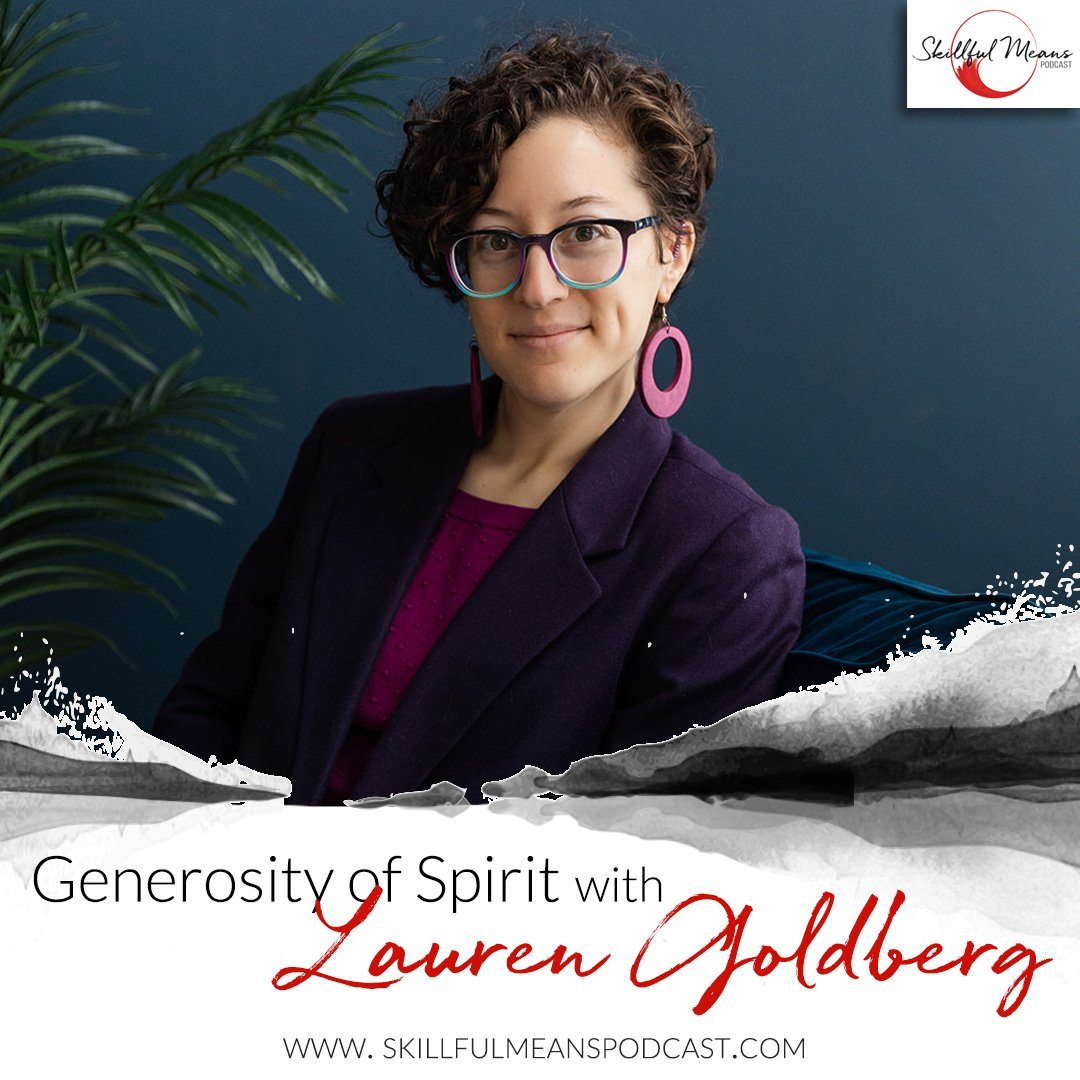
Thank you, Jennifer O'Sullivan, for giving me an opportunity to share more about Career Support Care Packages and talk about how we can show up to support each other with acts of generosity and embrace our unique magic in the process ✨
Give it a listen or a read. Transcript available below.
Originally posted on SkillfulMeansPodcast.com:
“In Part 3 of the Awakening the Heart series, we're looking at why acts of kindness and service are powerful resilience-builders — possibly the exact things we need if we're to overcome so much divisiveness in our relationships and discourse.
To understand why a generous spirit is so supportive, we explore the Buddhist and Yoga concepts of dana (generosity) and seva (selfless service) and how they relate to modern psychology's hope theory (hat tip to CR Snyder).
Then Jennifer is joined by friend and colleague Lauren Goldberg to talk about her simple but brilliant Career Support Care Packages, which perfectly illustrate how generosity can restore our sense of agency and hope when everything feels so dispiriting.
Highlights include:
how the Eastern philosophical traditions from India view dana and seva
how willpower and waypower fuel hope
why helping others should be in your resistance/resilience toolkit
how Lauren designed her care packages to support both sender and receiver
thinking about service not as self-sacrifice but as a way to put your skills and talents toward the greater good
Links
Get in touch with Lauren Goldberg: https://laurengoldbergcoaching.com/
Send a Career Support Care Package: https://laurengoldbergcoaching.com/career-support-care-package
Building Movement Project's Social Change Ecosystem Map: https://buildingmovement.org/our-work/movement-building/social-change-ecosystem-map/ “
-
Welcome to Skillful Means Podcast. I'm your host, Jennifer O'Sullivan.
Hey everyone, I hope you're doing well. Maybe you can tell from the sound of my voice that I'm feeling kind of excited. And that's because I've invited my friend and colleague, Lauren Goldberg, to come on the show and talk about a project she's launched.
Before I get there, let's rewind back to around April, May of this year, so 2025. And like a lot of people, I was feeling a bit down and out, and I was thinking about how easy it is to just fall into hopelessness and feel lost amidst all the chaos that's happening in the world. And a friend of mine just this week referred to it as dispiriting times, which I think really captures the mood really well, dispiriting.
And it's no wonder we feel dispirited when the problems we face are happening well outside most of our spheres of influence. So I have this other friend, and she's not a close friend, but in my pre-kid stage of life, our friend circles overlapped, and we saw each other pretty regularly. Anyway, this friend is currently a junior member of the US House of Representatives.
And it's clear that even in her position, she does not have much power. And if someone like that can't affect much change, I do wonder often, how can I possibly make a difference? This, my friends, is dark hole thinking.
And it's understandable. But this episode is all about how to claw yourself out of that hole, if you're there, and nurture hope, even in this dispiriting era. So here on the show, these past couple months, we've been exploring various aspects of awakening the heart.
What we would call in Buddhism, cultivating Bodhicitta and committing to the path of Bodhisattvas, or enlightened beings. One of the most important and potent aspects of walking in the footsteps of enlightened beings, is going out of our way to help people. As we discussed last month, the compassionate path is not just about being nice.
It's about being actively engaged in supporting our communities. And here's the thing about helping people. It feels good.
But it's more than just pleasurable, it's fulfilling. It gives us meaning and purpose, which according to Viktor Frankl, can get us through the very worst of circumstances. Generosity of Spirit not only reinforces our social bonds, but it also generates hope, boosts resolve, and will help us overcome inevitable disappointments and setbacks.
“And honestly, of all the tools in my toolkit, this is the most important one. Whenever I find myself slipping into the darkness of despair, recommitting to service has gotten me out of it every single time. And this is why I'm so excited to bring Lauren on the show.
While all of this was on my mind, Lauren popped up in my social feed with a donation-based offer that was so simple and yet so potent, it took my breath away. I know I met risk of overselling it a bit with my enthusiasm, but what struck me the most was that Lauren's act of generosity was actually pretty niche. And it reminds me that even though our problems are big and complex, each of us as individuals really does have a zone of influence where we can create impact, even if it's just one person at a time.
So yeah, we do need some big and powerful players to step up, but that doesn't mean the rest of us are relegated to the helpless sidelines. Before Lauren joins us, we're going to explore the Buddhist and yogic concepts of dana, which means generosity, and seva, which means selfless service. And we're going to look at how they relate to modern psychology's hope theory.
By now, psychology researchers can tell us why volunteering, showing up to a rally, being a shoulder to cry on, or committing random acts of kindness feel so empowering.
So before I dive in to these South Asian takes on generosity and service, it's worth pointing out that all of the world's faith traditions place a heavy emphasis on charity work. Charity comes in many forms, including financial contributions and donating one's time, but also helping a neighbor sharing resources. And these days, we could also frame charity through the lens of using our social media platforms to raise the profile of important causes.
But since this is a podcast about Buddhism and yoga, which in many settings have unfortunately been kind of whittled down to physical practices abstracted from their philosophical underpinnings, I thought I might share a bit about how central these concepts of generosity and service are to dedicated Buddhists and yogis. I'll start with dana, which is both a Sanskrit and Pali word that usually gets translated as generosity or charity. Dana is a practice you'll find in all the main religions and philosophies from India, including Buddhism, Hinduism, yoga, Sikhism, and Jainism, because they all share roots in Vedic philosophy.
So all of these traditions consider dana to be one of the highest virtues. And you might recall from last month's episode that dana is one of the moral character traits of a bodhisattva. In other words, an enlightened person is a generous person.
Dana is expressed in material and immaterial ways. If you visit a Buddhist temple, you'll see offerings of flowers and incense and fruit placed around the statues of both the Buddha and other bodhisattvas. But like other religious traditions, community members are expected to financially support their temples and monastics.
In fact, Buddhist monastic communities around the world, including here in the US, continue to be supported through dana. The center I retreat at used to put a list of everyday things they needed on their website, like toilet paper, toothpaste, canned goods. And I just take some of those things on the list and have Amazon send it to them.
So that's a really common expression of dana. Volunteering is also considered dana. So if one doesn't have a lot of money to share, we can give time instead.
And in fact, in Buddhism, it's customary for teachers to offer their teachings freely, making them accessible to anyone. And at the same time, those who can are expected to support their teachers through financial contributions. Now the economics of being a yoga or mindfulness teacher these days make it difficult for someone like me to sustain myself on donations alone.
But I do still offer my online in-class by donation. And amazingly, in the five years I've been offering it, the generosity of some students has supported the practice of others. Now, I can't live off of the income from that one class, but those contributions way more than cover my Zoom fees and time.
And it's also in the spirit of freely sharing teachings that I offer this podcast. And this brings us to SEVA, which refers to volunteering or more specifically, performing acts of selfless service. In other words, helping without any expectation of praise or personal gain.
SEVA is a way of contributing to our communities and supporting humanity. So both SEVA and Donna both expect that our generosity, whether material or immaterial, is given freely and wholeheartedly without expectation of reward. Even though we also know that these practices purify our minds, and in the case of Buddhist philosophy, generate merit.
To put this another way, it's good karma, which may contribute to a more fortunate birth in a future lifetime, if you believe in reincarnation. As with a lot of things in the Eastern spiritual traditions, here we have a paradox. On the one hand, we really do receive personal benefit, especially from SEVA, which I'll expand on in a minute.
But if we do it because we're trying to hack our cosmic ledger, it's unlikely to work. That's a self-serving aim. It's a bit like when the Golden Age robber barons donated vast sums to arts organizations and charities.
On the one hand, yeah, they were contributing to some common good, but they were also doing it as a way of getting a leg up in their social circles. So it's not completely altruistic. But about those personal benefits, in Buddhism, it's acknowledged that wholehearted generosity is a component of true happiness.
When we give, it reduces our own suffering by helping us to let go of attachments to fleeting pleasures as we refocus our minds on more meaningful pursuits. Donna also helps us overcome our aversions, particularly by bringing us closer to others. It's hard to hate people when we develop mutually supportive relationships with them.
And psychology research backs this up. When it comes to building resilience, our social connections are the most beneficial. Even if we're the ones recovering, reaching out to help others like us dramatically speeds recovery.
And volunteering has been shown to boost all kinds of markers of wellbeing.
One mechanism for why generosity is so beneficial can be found in hope theory. And I know Renee Brown has talked and written about this, so once I get into it, it may ring a few bells. But the credit for hope theory goes to CR Snyder, who was one of the early pioneers in positive psychology.
The first thing you need to consider is Snyder didn't see hope as something that you just have or don't have. He viewed it as an active process. More specifically, hope is a mechanism for achieving our goals through what Snyder called willpower and waypower, which are also the ingredients of self-belief.
Willpower is a combination of motivation and determination. In other words, it's what we need to get things started and see them through. Waypower is about having both the agency to act and the ability to envision and create plans to achieve objectives.
We need both willpower and waypower to feel hopeful. So here's how this works in practice. And first of all, think of goals in the broadest way possible.
It doesn't have to be a thing that you do over the next couple of months. It can be very conceptual, like I want to contribute to reducing harm in the world. When we can see a pathway forward for achieving our goals and we believe we can achieve them, then we feel hopeful.
Hope in other words is not a kind of smushy, wishful thinking that things will just magically turn out. It's all about believing in yourself in a grounded realistic way. When you consider this, it's no wonder why we might feel so hopeless when faced with so many big complex challenges.
As I hinted at the top of the show, it's pretty unlikely that anyone listening has the agency to tackle all these problems by themselves. We just don't have that kind of access, nor are our big problems the kinds of things that one person can fix. But we actually aren't all that helpless when we focus on goals that are within both our zones of influence and expertise.
Part of way power is setting your sights on something that you have the capacity to influence. And it's okay if it's not at the highest level, because you can do a lot of great stuff in your local community, while leveraging skills you already have. So here's my example of how I put this into action.
Back during the last recession, I was teaching at several local yoga studios that were really struggling as class sizes dwindled. And one studio I worked at paused classes for a whole summer while they tried to hold on to their lease and ride it out on savings. But mostly it was a matter of classes going from like around 24 to 4.
Now instead of fretting over dwindling attendance, which I personally couldn't do anything about, I decided to dedicate myself to taking extra care of the people that were still coming. It was summer, so I started bringing cold cloths for people to put over their eyes in Shavasana and then some Agua Fresca for after class mingling. And I brought cucumber slices for my prenatal students, and I started to mix my own essential oil spritzers and then give them away.
None of this was impressive and it didn't really move the needle, but it made me feel helpful. And if not part of the whole solution, at least not part of the problem. And I delighted in dreaming up new little treats and I enjoyed making them.
And I really loved seeing how much my students felt cared for. Now in the beginning, I knew I was trying to turn my own attitude around. I was aware that marinating in ill will leads to suffering.
And I was aware that even small acts of kindness are just as beneficial for the giver as the receiver. But I didn't know how beneficial it would be. And it made me a believer in the importance of little things.
So in terms of hope theory, I set out to create small moments of delight for my students. So that was my goal. I had way power and that I was empowered to do it like the studio let me.
And it was doable within my financial and time constraints. And I had a sense that it would be fun, so it was easy to muster up the willpower. And that willpower was fueled by my students' reactions.
The more delighted they were, the more I wanted to do it. So here are but a few benefits to cultivating hope. One, it gives us a way to handle stress, so it is a skillful coping strategy.
It also helps us find workable ways to overcome challenges. Hope increases well-being and it fosters social connections. Okay, so back to Donna and Seva.
When you connect them to hope theory, hopefully you can see why they're such potent practices. Acts of kindness, generosity and compassion are beneficial because they help us spin up a kind of hope flywheel that keeps fueling itself. Firstly, they restore our sense of way power.
Helping one person, supporting a local cause and generally working to improve our little corner of the world helps us to feel like meaningful agents. And when we do things within our zones of genius or expertise, the pathways to achieving our goals are easier to see. And secondly, generosity also builds our willpower.
Each time we reach out and help and get that positive feedback, we're more likely to do it again. In such a complex world full of intersecting crises, our problems can feel overwhelming. Giving of ourselves and helping others will chip away at hopelessness.
And maybe I am a bit of a delusional optimist, but I do believe in the compounding effect of everybody pitching in where they can.
~~~
So now that we've gone over Donna and Seva and Hope Theory, I'm really excited to bring Lauren on to talk about the project that she launched that illustrates all these concepts really beautifully. Now, I met Lauren back in a feminist marketing course. Throughout that year, we worked together in breakout rooms and on coworking calls as we tried to figure out how to dodge conventional marketing wisdom in order to build our businesses in a non-exploitative way.
Lauren popped out to me because she was building a body of work around kind careerism as an antidote to toxic professionalism. Having opted out, or maybe more accurately driven out, of the traditional career ladder myself, I appreciated the challenges Lauren was trying to address. Now, over the years we've kept in touch, and I've watched her build a thriving coaching business, helping change makers and social impact professionals navigate career transitions and workplace challenges.
Lauren, having lived experience with multiple disabilities, including ADHD, dyslexia and partial deafness, is also a disabilities activist. I experience Lauren as among the most thoughtful, caring and encouraging people I know. She is the first person I'd call for career coaching support, and is who I recommend to people the most.
I invited her on the show to talk about her career support care packages. This is a tool she created to help people activate their generosity by sending a digital care package to someone going through an array of work challenges. We're talking job loss, really destructive professional relationships, burnout, or any other kind of work-related stressor you can think of.
Now, I've gone through layoffs and also felt handcuffed to a dead-end job because of an uncertain job market. So when I saw Lauren pop up in LinkedIn with this offer, I just knew it was something that a lot of people would appreciate. And I'm really thrilled to have her talk about what it's been like for her to put this together.
My hope is that hearing from Lauren will help you think of ways that you can draw on your skills, talents, and values to empower yourself during these dispiriting times. And just a quick comment about the sound quality of the interview. We needed to use different software than what I usually use to record the podcast, so apologies in advance if it sounds really different and sometimes not quite up to standard. Meanwhile, I'll be over here taking care of my perfectionist parts.
[Jen] Hi, Lauren. Thanks for joining me on the show and coming on to talk about your care package.
[Lauren] Thanks for having me. I'm excited to chat.
[Jen] So in our conversation today, I'm really looking forward to talking to you about two things. First, I want folks to hear about your career support care packages because it's a really brilliant example of how regular people can show up and support each other during these times. You can't see my air quotes. Well, you can, Lauren, but the listeners can't. But these times we're using a euphemism for all of the challenges that everybody's going through right now. I also want to get your thoughts more broadly on how acts of service and showing up with generosity even in small ways can support not only others' well-being and doing that work, but also our own well-being.
Let's start with the care packages. Can you explain a little bit how it works and also how you came up with the idea?
[Lauren] Sure. At the beginning of the year, I was just witnessing so many people struggling with career-related stuff and just everything with the new administration and just to copy you with the air quotes, all of the things, just like the challenging times. And I was finding that a lot of people were getting laid off from their jobs, and I really wanted to make my career, self-discovery and leadership coaching more accessible to people who are maybe not in a position to buy a coaching package.
And beyond that, just like, how can I be helpful? How can I make an impact? How can I use my skills to make the world a better place?
I'm always asking that question in my, I mean in life, but in my business. And so I thought, well, maybe I can create a podcast or maybe I can do some sort of voice note coaching. And none of these ideas were really clicking with me.
And when I was talking to a friend about what I was thinking, which at that point was sort of like emotional first aid voice notes.
[Jen] I like that too actually.
[Lauren] Yeah, exactly. So I was kind of playing around with this idea and was struggling with how to deliver it. And my friend said, you know what?
That sounds like something that I would love to send as a gift to a friend who is out of state who I can't be with physically to support. And that just like was the epiphany moment where I was like, oh my gosh, I can create an entire care package with not just voice notes, but also reflection questions and a guided meditation and nervous system calming techniques for stress busting. So all of this kind of came together in really what was a very creative time period for me.
But it also allowed me to address specific situations. So creating care packages for specific career challenges. So for example, layoff and job loss, prolonged unemployment, toxic work environment, unsupportive work environment, etc, etc.
And I have nine different ones. So that's how the idea came about. And the way it works is you can gift a care package to yourself or you can gift it to somebody else.
Where it is right now, I've launched it as version 1.0. And I'm incubating on changes for version 2.0 and how to improve the process. But the reaction has been really, really awesome so far.
[Jen] It sounds a little bit like you're tending a garden. So some things you might prune back, but other things add a little fertilizer and see what happens. I love that.
You know, when you first posted about this on LinkedIn, I was that very day trying to brainstorm my own, how can I help? How can I show up? How can I meet this moment?
Problem. So I was already in this headspace. And then I open up the window and I look at LinkedIn and I'm like, oh my God, that's brilliant.
That's just so brilliant.
And I was immediately transported back to when I was in college. I went to college out of state. This is, I'm, I think my listeners know how old I am.
This is pre-internet and we still paid for long distance phone calls. So I was feeling quite cut off from my family and friends back home in many ways. And there was a person in my local community where my college was, that I think they must have spent a flyer about their like birthday cake service, or their like college student care package, or here, let's, you know, you work, it's final, send your kid an unbaked lasagna that they can put in the oven.
And my mom didn't do it a lot, but enough times over my four years of college that these little care packages really made a difference. And I thought that was really brilliant when I saw your care package come through because it really invoked that memory for me. And then I realized I wasn't the only one because that post, I don't know how much engagement you got on that post, but you got a lot from what I could see from the outside.
A lot of people showed up to tell you what they think. And I'm just wondering what that was like for you.
[Lauren] I mean, it was incredible. I mean, for a while, anytime I saw one of those, I just was getting choked up because folks were like, wow, this is such a brilliant idea. This is so smart.
I'm bookmarking this. Like, I can't wait to send this to folks. This is so cute.
Like, they're just really like the people were taken by how unique it is, really. I mean, especially given that it's created for people who are going through career challenges. I mean, the alternatives are what?
Like, sending a fruit basket or sending a, you know, like not knowing what to say in a text message. They don't really make reading cards for that. And it can feel like overstepping to say, well, maybe you should talk to somebody or maybe you should get professional help, right?
So having this care package put together with tools that are valuable to their situation, I think people were just so taken by it. And especially the people who have gone through some sort of work trauma, like they've experienced layoff and they're like, wow, this would have been so amazing to get something like that when I was going through it, when I was going through challenges. And so a lot of those folks have reached out to me to say, this, this is so needed.
That's like, I wish there was something like this when I was going through my own work trauma, my own work challenges. So that was really amazing and like really struck me. And just feeling all those feels.
And you know, as a creative, it's nice when you do get that external validation. But I think I was excited about the idea. Like I knew it was a good idea.
I was excited while I was building it. Like I was in a flow state while I was building it because I was so passionate about it. And then after I launched it, there was some questioning like, well, like, is this enough?
Like what impact am I really making? I'm not making like systemic change with this product. And not a spiral, but just questioning that.
So to have people react so strongly to it, and tell me this is so needed, it really did sort of take me out of my own like negative headspace about it.
[Jen] I remember you posted a follow up thanking all the people for their reactions. And I was getting choked up watching that follow up too. It was like, it just was like, like it was, I know love bomb is like a negative term, but I just feel like there was a kind of upward spiral of good feelings happening across time and space.
And it made me feel in that moment to see you getting such good positive feedback as an observer of that, I was feeling really good and hopeful getting to see something like that happen because otherwise we're so inundated with all the bad stuff that's going on and the sort of human interest stories on the news.
We don't even have those anymore.
There's not a lot of positive highlights going out into the world. And I just was marveling at how good it was making me feel to even just watch from afar.
[Lauren] Yeah. Thank you. Thanks for saying that.
[Jen] And get to see you. Lots of praise heaped on another person. It felt really good.
It's like, oh, we can't support each other even during these times. Like not everybody's a mean, self-interested goon.
[Lauren] Yeah.
[Jen] I'm just curious if you've gotten any feedback from anybody about what's it meant for them to receive these or to be the sender of such a thing and how that's landing in terms of their well-being.
[Lauen] Yeah. Some of the biggest feedback that I've gotten is just how much heart was poured into this, that people can really feel that, and that it really does feel like a gift, like a gift box. I've designed it so it's like very literal.
Like you, there is a picture of a box, and then you click it and it opens, and then there are like different items in the box that you can click on. And it's very interactive, and it feels like you're actually getting a physical gift box, even though it's a digital product. So people have really liked the experience of receiving it.
But beyond that, I've also heard from folks that the tools have been helpful. So I had somebody say, I have an interview on Monday. I'm definitely going to use these like nervous system calming techniques before my interview.
And I had someone listen to one of the voice notes and say, Oh, wow, I really I didn't realize that I was, you know, like experiencing this thing that you explained so well in the voice note. Like I didn't even realize it. And so it was helpful for me to hear you talk about that in in the voice note.
And just look at my situation in a different way. So that has been some of the feedback that I've gotten so far. And then I've had other people who have told me that.
They liked receiving the care package, and then they were like, and I'll look into it more specifically later. Like there was like almost like too much in it that they were like, I can't look at this right now, but like I just loved receiving it. And I I think my initial reaction was like, no, you got to dive into it.
But upon kind of reflecting on that, the purpose of the gift is to be given and to be received. And so even if they don't use any of the tools, even if they just get the gift and feel good receiving the gift and feeling supported by a loved one, or maybe they gifted it to themselves, and that's self-care right there, you know? That is a purpose that it serves just in itself, being received and making someone's day just spreading a little bit more delight.
So I feel good that folks are sending it. The folks who are sending it feel good. And then the people who are receiving it feel good.
[Jen] Those of us who are in helping professions, lately with the complexity of things happening, you touched on this a little bit about, you know, how can we make a difference when we're dealing with intersecting crises? And, you know, I'm observing that even people who have some amount of power in our world can't seem to stop this freight train from barreling down. So I know I've been having trouble finding pathways to do the helping.
And, you know, what do people need, whether they respond to? And, you know, in putting this out there, what have you learned about what people need right now in terms of support?
[Lauren] I have learned that it's very common that people don't know what they need.
That's what makes it hard for, like, to know how to help those folks. You know, I've offered a variety of different tools in that care package, from a voice note to a guide to meditation, to list of activities that's calming, to reflection questions, just different ways in which folks can help themselves and go further down the path of self-discovery to figure out what they need in this moment. I think that the truth is a lot of people don't really know what it is they need help with, but to create the space for them to reflect on what is the immediate thing that you need.
Is it to just take a shower and you'll feel better after you, you know, you feel that much better after you take a shower, or is it you need to quit your job and you need to make this big life decision, you know, I mean, like they're just creating space for people to actually think about that. Um, and slow down and see what comes up for them when they do slow down. I think that is the biggest thing.
[Jen] It sounds like what you're saying is that being a good friend, being a listener, is, is, you know, sounding board with without being an advice giver. We think about coaching as, as a, as a sounding board for other people, but it's a companioning process is how I think about it. And I think when we're feeling as individuals with the loved ones in our lives that are really going through it, or even when we're going through it and what we want from others is really just somebody to listen and maybe kind of let us lean on their, lean against them a little bit.
[Lauren] Yeah. Yeah. And as a coach, like in going through skills training for coaching, like you realize that you're not here to fix somebody's problem. You're here to help them figure out what they need and take that next step.
So I know when I call my mom on the phone and I'm complaining about something or I'm venting about something, she wants to relieve my suffering as quickly as possible and say, well, do this, do that. You should do this. Have you thought about that?
Have you thought about that? And sometimes what I, most of the time, what I really need is just space. To feel held and supported and listen to and someone who's who says I'm going to be, I'm going to be there with you no matter what.
[Jen] Yeah.
I'm reminded of, I don't remember who said this, but the greatest gift that we can give others is our presence. And, you know, in this larger topic of this episode of the podcast is about being of service and offering generosity. It can be financial generosity, but it can also be our time and our presence.
And that that really does matter. Like, it can be so easy to fall into despair and think, oh, the problems are so big. I can't do anything about it.
And it's like, I don't have to do anything or I can't do anything. But what you're describing is something that each and every one of us can offer to others. And that it's more impactful than we might really appreciate.
[Lauren] And I think with the care package too, the way that I designed it too is not like, oh, you're going through job loss. Here are things you need to do right now. It's like creating space for somebody to feel the feelings, feel the grief, reflect on where they are in this moment, and figure out what their immediate next step is, or whatever is appropriate for those other specific situations.
But job loss is just my example there. As a coach, what I would like to incorporate more into is creating opportunities for people to get coached if they want it, to experience coaching as part of the care package experience. So those are things that I'm incubating on right now.
[Jen] Thinking about this gift of presence and acts of kindness, sending a care package like this is a small act of kindness. How do you think they help us address bigger challenges?
[Lauren] So a comment that you left on my LinkedIn post about the care packages was, you are the exact right person to offer this. And I really needed to hear that because when you're questioning what your role is in the greater movement towards a better world, it is so grounding once you finally kind of figure out what it is, and people recognize it in you.
Because you probably didn't see it in yourself. And so for me, I'm able to now realize like I, and maybe I'm not necessarily going to be an organizer or a storyteller or a teacher, but I'm going to be a healer and a cheerleader and a joy spreader and a, you know, like somebody who will help you get your spark back when you've lost it. And that is my role as a coach for people who want to make the world a better place, but are just feeling stuck and not sure how they want to make the world a better place.
You know, feeling what I call, what I call career identity crisis. And it's often the folks who are like, I want to make an impact, but I'm not sure where and I'm not sure how to figure out what that's going to be. And so I know that's my role in this movement of making the world a better place.
And as we are trying to move towards interdependence rather than individualistic culture and tendencies, I know that's the role that I play. And I have people in my community who help me get my spark back when I lose it too. I really wasn't sure what kind of impact the care packages were going to make.
And I was worried that it was going to be silly, that it's just not going to contribute to systemic change and questioning the impact. And to be able to be reminded, no, like this is needed in the world, to have people tell you that this is needed in the world and you are the exact right person to offer it is very deeply meaningful.
[Jen] Well, that's because I know you to be a really heartfelt person in all of my interactions with you. And I know, and partly why I wanted to bring you on the show to talk about this is because I know you think about all these different components, even if it's not in the foreground while you're building something, I know it's on your mind. And I know you were thinking this way.
And the fact that you were able to come up with something that actually touched on all these things that I know you care about was just really impressive. And it's been such a delight to see you promote it. And I saw a picture, you were in a physical space promoting it.
I love that.
[Lauren] Thank you. Thank you. Yeah.
[Jen] One thing that you were saying before about, you were talking about where you, now you have some clarity around what role you have to play in the larger movement towards making the world a better place. I think I have a similar orientation. I would call it, like, I think of myself as being part of the pit crew.
I also second guess that a lot. And then I came across a few years ago. I don't know if you're familiar with the Building Movement Project.
They have a framework of different roles that people can play in movements, and healers, and helper, and educator are one of the nodes on that.
[Lauren] Yes, exactly. Yes, I have seen that. And as you're making this shape, like a circle with your hands, that's exactly what I was thinking of too.
[Jen] And as soon as I saw that, I remember just feeling like my shoulders relaxing a little bit because I too had this idea that a moment needs more. And how do I like find the capacity to do more when it, when actually it's not really part of my skill set or talent, and not even the way I think. And so I think it is important to kind of ground ourselves in, and that a movement, like you said, is built on interdependencies.
And every different person on this wheel is doing their kind of job to move the movement forward, and that none of those little pieces are less significant than any of the other ones. Has creating this offer, Lauren, shifted or changed anything about how you're approaching your coaching practice, or how you think about helping others more generally?
[Lauren] I don't think it changes how I want to help people. I think the delivery for that help has changed, but I don't think it's actually changed what it is that I want to help people with, and how I help them. It's just the media and the craft that I'm using and which I do that has changed.
And I feel like my one-on-one coaching is very playful and very, we are co-creating together. And as I'm putting these care packages together, it was like, it was deeply creative and very, you know, like I was a kid again in my parents' basement, inventing things with popsicle sticks and, you know, pipe cleaners and markers, glue and rubber bands and literally like putting something together and being like, this is a, I invented a thing, you know, not with me as a kid. And so I feel like if anything, it's just sort of reinforced who I am and what I bring to the world and how I bring that to the world.
[Jen] I love that because I think it can be easy for people who do coaching or mentoring or consulting, but there's really only one way to deliver this. And it's, you know, this extended engagement. And I've caught myself telling myself that story, too.
I'm being surprised at how a little asynchronous touch point can actually turn things around in a way that I hadn't expected. And kind of opens the box a little bit around how I might show up for people, especially at more affordable price points, if we're honest. So once we start to wind down, I'm curious if there's anything else you'd like to share or say to the folks listening about how they might show up for their people.
[Lauren] Well, two things. So one is, I do think that a lot of folks learn that showing up for others means self-sacrificing.
And people don't just get burnt out on work, they get burnt out on being something for everybody else. Yeah, whether that's at home or social or just, yeah. So I think making sure that you're also open to receiving help is a big part of that process.
And then being able to show up for others, which I learned this year after like being off and on really sick and chronic fatigue and not being able to show up in my full energetic self and having to accept help and ask for help.
And be willing to receive that help and not feel sorry, but just know that these are relationships with people that I know I will be helping down the road and have helped earlier on the road. Yeah. And then the second point is a lot of people don't realize that showing up as themselves in their, like stepping into their most authentic version of themselves and shining their light on the world, whatever that looks like, is inspiring to other people.
Like, just living your life authentically with self-assurance, with self-love, with that type of energy, people pick up on that and it is a message to other people in and of itself. So I think that often goes as an understatement, and I don't think it can go overstatement.
[Jen] It's funny that you say that because just earlier today, I had my therapy appointment and we were talking about that. I'm doing, because I'm in this Positive Psychology Diploma course, and I'm doing a project on authenticity. And one of the things I'm noticing coming up in my own experience is, I can just see this person, there are those people that walk into a room, and they are just so at home in themselves.
And they can be the quirkiest people. It doesn't matter. Like they can be really wild, creative, bohemian, wackadoodles.
And they just sweep into a room and it magnetizes everybody. And those are the people that I'm like, I wanna be like that. I wanna be so self-assured and at home in myself, that I can split into a room and just be my kooky self.
And I think you're right. I think those people don't realize how much they're sort of giving permission in a way for other people to be themselves too. And I love that.
And so thinking about the ways in which we can be generous and of service to others is also, it is quite a gift to just be ourselves. I think there's a Joseph Campbell quote in there somewhere.
So that was to send up our conversation a little bit for folks. You are looking for ways to be of service and support and be part of the solution. It doesn't have to be big grand gestures.
These little things do matter. Our presence, being there for people is important. I love what you said about not overdoing it, burning ourselves out.
It makes me think about what is it in our culture that has attached this giving and generosity and service has to be coupled with sacrifice. Instead, can we look at the skills that we already have on board, the talents that we already have on board, and we can just bring those to bear in a more naturalistic way than feeling like my gift of service, the gift of generosity has to be somehow painful or it doesn't count. So I was just kind of rolling back that thinking on that.
Also, at the end of the day, being ourselves is a gift for a lot of people. Thank you.
[Lauren] Thank you. Thanks for having me.
~~~~
Okay, well, I hope you enjoyed that chat with Lauren as much as I did. If you want to send a career support care package, you can visit laurangoldbergcoaching.com and click on the link in the menu, or check the show notes for a direct link. I've also put a link to the building movement projects, Social Change Ecosystem Map that Lauren and I talked about.
It's got a whole list of roles we can each play in making the world a better place for everyone.
Coming up next month, we're looking at self-compassion and grace. While we're walking the path of the Bodhisattvas, we're bound to step in it from time to time, but we can't let our mistakes take us out of the game. So we'll look at some ways to help you get on your own side and keep on keeping on.”
If you've got any feedback for this or any other episode of the show, feel free to send me an email to feedback at skillfulmeanspodcast.com. You can also text me your feedback using the link at the top of the show notes. If you like the show, please leave a rating and review and share it with a friend.
Well, thank you for joining me and Lauren today. And a big heartfelt thanks to Lauren for coming on the show. Until next time, may you meet each moment with courage and compassion.
